


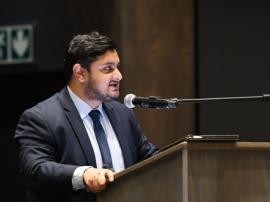
The Deputy Minister of Finance, Ashor Sarupen, has reflected on the importance of policy reforms in South Africa - considering the critical role they play in unlocking economic potential and improving service delivery.
In October 2020, government launched Operation Vulindlela (OV) against the backdrop of deep structural constraints that had, for too long, held back South Africa’s economic potential.
“Our starting point was a clear and deliberate diagnosis: we undertook a root-cause analysis of why our growth had remained stubbornly low for over a decade. This analysis identified a handful of binding constraints that were holding back investment, limiting competitiveness, and undermining productivity across the economy,” the Deputy Minister said on Friday in Johannesburg.
Sarupen was addressing the launch of the Business Leadership South Africa (BLSA) Reform Tracker, an innovative online platform designed to monitor and assess the progress of key government reforms that impact the business environment and economic growth.
The Reform Tracker evaluates nearly 240 reform deliverables across three categories: criminal justice, governance, and economic reforms.
Each reform is reviewed quarterly and scored based on its progress—whether it’s on track, facing challenges, or encountering critical obstacles.
The BLSA Reform Tracker is expected to complement OV’s own public reporting.
OV is a joint initiative of the Presidency and National Treasury that draws on a small but dedicated technical team embedded in both institutions to accelerate the implementation of structural reforms and support economic recovery.
“The conclusion was that if we could tackle these constraints head-on, we could unlock significant private sector investment, drive job creation, and place the economy on a more inclusive and sustainable growth path,” Sarupen said.
With OV, the Presidency and the National Treasury work alongside line departments, providing targeted capacity, problem-solving support, and political momentum to accelerate delivery.
Departments remain accountable for implementation, while OV’s role is to clear bottlenecks, maintain focus, and ensure reforms stay on track.
Phase I of OV focused on five priority areas where reforms could deliver high economic impact: Energy security and electricity market reform; freight logistics reform; water-use licensing and bulk water infrastructure delivery; release of high-demand spectrum and modernisation of telecommunications as well as reforms of the visa regime for skills, tourism, and investment.
“These were not chosen at random. Each was the result of detailed economic analysis showing that weaknesses in these areas were at the heart of South Africa’s low growth trap.
“The results of Phase I are clear. In energy, the removal of the licensing threshold for embedded generation opened the way for over 14,000 MW of private generation projects to register with the National Energy Regulator.
“In telecommunications, the successful auction of high-demand spectrum after more than a decade of delay is already enabling lower data costs and network expansion,” the Deputy Minister said.
In water, licensing turnaround times have been cut from more than 300 days to under 90 days.
In freight logistics, third-party access to the rail network and reforms at key ports are under way.
Furthermore, a new points-based system for critical skills has been designed for visas, alongside the digitisation of visa processes.
“As Phase I ended, we convened a workshop with departments, the Presidency, National Treasury, and partners to reflect honestly on our progress, our lessons, and the road ahead.
“The message was clear: while much had been achieved, the work was far from done. The enabling conditions created by Phase I reforms now needed to be deepened into systemic change, and there were other priority areas where reform was urgently needed,” he said.
Phase II of Operation Vulindlela was approved by Cabinet in March 2025 and builds on the achievements of Phase I, deepening reforms in the original priority areas while expanding into new domains that are essential for growth and inclusion.
It was aimed at addressing local government capacity and basic service delivery, spatial integration and housing delivery and digital public infrastructure.
“One of OV’s defining features has been the consistency of the core team and the sustained commitment of implementing departments. This stability has allowed us to maintain institutional memory, build trusted relationships, and keep reforms moving despite political and administrative changes.
“We are now working closely with departments to finalise detailed delivery plans for each Phase II reform. These plans will set clear milestones, assign responsibilities, and define the support needed from OV to remove obstacles. This is the hard work of reform, aligning capacity, resources, and accountability to ensure delivery,” the Deputy Minister said.
Research by the Bureau for Economic Research suggests that fully implementing the original Phase I reforms could raise South Africa’s potential Gross Domestic Product (GDP) growth rate by around 1.5 percentage points above the baseline of approximately 2 percent.
Reforms are the most direct route to raising South Africa’s potential growth rate, increasing competitiveness, and creating jobs
“Treasury is undertaking its own modelling to estimate the combined impact of Phase II reforms on growth, investment, and employment. This evidence will be critical in maintaining political will and securing the sustained effort required for reform.
“The reforms we are implementing now will define our economic trajectory for the next decade. They demand persistence, collaboration, and an unwavering focus on outcomes. Operation Vulindlela is a vehicle for that focus, which is pragmatic, data-driven, and relentlessly geared toward unlocking growth,” the Deputy Minister said. -SAnews.gov.za


