


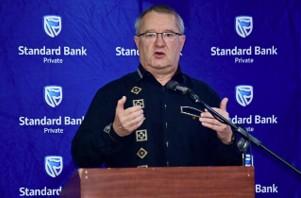
KwaZulu-Natal Finance MEC Francois Rodgers has urged young entrepreneurs to build businesses on hard work, integrity and sound financial management.
Rodgers made the call during a recent engagement with youth in business, held in partnership with the South African Institute of Professional Accountants (SAIPA) and Standard Bank.
Rodgers shared his perspective on the impact of young professionals on the economy and their contribution to the development of a capable and ethical State, as well as the growth of KwaZulu-Natal.
He said entrepreneurship can create income and employment opportunities for young people, highlighting the role of youth in business in growing the provincial economy and contributing to a capable and ethical State.
“It takes courage to build a business. You must work hard in order to create businesses, generate income and opportunities for other young people,” Rodgers said.
He encouraged young people to uphold integrity in their business dealings, stressing the importance of ethical conduct to achieving lasting success.
Rodgers clarified that the provincial Treasury does not directly fund entrepreneurs but remains available to assist with financial management guidance.
He encouraged young people in business to strengthen their financial management knowledge to help them run sustainable enterprises.
Reforming failing State-owned enterprises
Turning to the management of public finances, Rodgers said South Africa does not lack policies, commissions or turnaround plans for State-owned enterprises (SOEs), but needs the political will and institutional discipline to implement meaningful reforms.
He said the focus should shift from diagnosing the challenges facing SOEs to delivering practical solutions that improve their performance and ensure they provide value to the public.
According to Rodgers, State ownership must serve a clear public purpose, such as providing electricity, transporting people and goods, delivering water, developing infrastructure and supporting economic growth.
He said SOEs should be assessed on their ability to fulfil their mandates, deliver services effectively, remain financially sustainable and uphold ethical governance.
“If the answer is repeatedly no, government has an obligation to act. There is nothing developmental about continuously funding failure,” Rodgers said.
He warned that continued bailouts of struggling entities placed pressure on public finances, diverting resources that could otherwise support schools, clinics, roads and water infrastructure.
While government support may provide temporary relief, Rodgers said it cannot substitute structural reforms.
“Public financial support cannot be a blank cheque. Assistance should be conditional, transparent, time-bound and linked to measurable reform. Accountability must follow authority.
“Boards cannot claim authority when decisions succeed but blame government when they fail. Executives cannot be rewarded while their institutions fail to deliver. Shareholder departments cannot appoint boards and then distance themselves from poor governance.”
He said board appointments should be transparent and based on competence, while political interference in procurement, appointments and commercial decisions should be avoided.
He further called for early-warning systems to identify financial and operational problems before they escalate into crises, as well as decisive action to address recurring audit findings.
Rodgers said the solutions must be tailored to individual SOEs and must include improved governance, restructuring, consolidation, strategic partnerships and partial private sector participation.
“Where an enterprise has no sustainable mandate, credible recovery path or defensible public purpose, government must be prepared to consider closure. We do not have unlimited fiscal resources to sustain permanent non-viability.
“As provincial Treasury, our responsibility is to protect the fiscus. Treasury should not simply be the institution that says “no”. We must ask whether a proposal is affordable, lawful, implementable, and capable of delivering value,” Rodgers said.
He emphasised that public confidence depends on reliable services, well-maintained infrastructure, competent appointments, and accountability for the use of public funds.
“Our objective should not simply be to preserve State-owned enterprises. It must be to make them worthy of public ownership.” – SAnews.gov.za


