


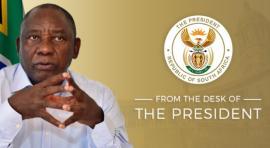
President Cyril Ramaphosa has emphasised that women must be at the forefront as the country holds the first National Convention of the National Dialogue set to be held this week.
The President was addressing the nation through his weekly Presidential newsletter on Monday.
The convention, which forms part of the National Dialogue process, will bring together 200 organisations from 33 different sectors across the country.
“On Friday this week, organisations from across South Africa will gather at the National Convention in Pretoria to kickstart the National Dialogue process.
“Given the history of women’s struggles in our country, it is therefore to be expected that at this critical moment in our history, women will once again come to the fore and participate actively National Dialogue process,” he said.
President Ramaphosa noted that women make up more than half of South Africa’s population – making their contributions critical to the dialogue.
“Women are affected by every political, social and economic issue in the country. Likewise, every crisis, whether it is unemployment, crime or climate change, affects women equally and, in some instances, more than men.
“Recognising that the lives of women are bound up with the future of the nation as a whole, we are counting on women’s groups and organisations to mobilise around the National Dialogue process.
“As government, working in partnership with the various stakeholders, we have committed to ensuring women are equally represented across the structures supporting and guiding the process,” the President said.
He emphasised that “we have to ensure that all women are represented” during the process if every sector’s voice is to be heard.
“This means a concerted effort to mobilise young and old, urban and rural dwellers, women from different ethnic and linguistic communities, women with disabilities, and LGBTQI+ [ Lesbian, Gay, Bisexual, Transgender, Queer and Intersex+] people.
“The reality is that women’s struggles are not all the same and we should not assume they are. Although they may be similar in certain respects, the issues and challenges facing rural women and women in traditional communities differ vastly from those of women in urban areas with access to education, resources and public services.
“This was one of the points made at last year’s South African Women’s Pre-National Dialogue convened by the Institute of Justice and Reconciliation. It emphasised that the National Dialogue process should focus on all issues affecting and impacting women, and that diverse perspectives and priorities of all South African women must be reflected,” he said.
Uplifting women
With the country commemorating Women’s Month in August, President Ramaphosa noted that women have consistently “organised to ensure that their voices, consent and participation remained central to all decisions affecting them either directly or indirectly”.
“The inclusion of the gender equality clauses in the Freedom Charter was heavily influenced by the Federation of South African Women (FEDSAW) formed in 1954. More than three decades later, the Women’s National Coalition, which was formed in 1992, played a formative role in ensuring that these passages were reflected in South Africa’s democratic constitution.
“From the protests against the pass laws, to the so-called beer-hall protests of 1959, to the rent boycotts of the 1980s, to the contemporary protest movements against gender-based violence, South African women have a proud history of standing up and being counted,” he said.
The President called on all of society to uplift the voices of women during the dialogue in recognition of the 20 000 women – led by struggle heroes Lilian Ngoyi, Helen Joseph, Albertina Sisulu and Sophia Williams-De Bruyn – who marched to the Union Buildings in protest against the apartheid government’s introduction of pass laws against black women this month in 1956.
“With the first National Convention taking place during Women’s Month, we call on all sectors of society to come together to ensure the full participation of all women in the National Dialogue.
“This would be the most fitting and powerful tribute to the legacy of the pioneers of 1956,” President Ramaphosa said. – SAnews.gov.za


