


As South Africa marks the beginning of Women’s Month, private sector institutions have reaffirmed their commitment to work with government to ensure women’s full participation in the economy.
The commitment was made by representatives from various institutions during the official launch of Women’s Month 2025, held in Johannesburg on Friday.
Absa Group’s Chief Strategy and Sustainability Officer, Punki Modise, emphasised the importance of building on the legacy of iconic women leaders, such as struggle stalwart Charlotte Maxeke and the women of the 1956 march.
"Every step forward for one woman should be a path easier for the next woman. It would be a missed opportunity for Absa not to build on the legacy they left. As we think about solutions, particularly for women, we make sure we don’t forget where we are coming from," Modise said.
In 2024 alone, Absa spent approximately R3.8 billion procuring goods and services from women-owned businesses. However, she noted that the financial system was not originally designed with women in mind.
"We still continue to challenge the status quo, because the [financial] institutions that we work in today were not built for women [but] under completely different dispensation. As we go forward, government should open the policies and ensure that women can be effectively supported,” Modise said.
Modise stressed that unlocking economic value, measured in trillions, depended on giving women access to opportunity and right spaces.
She said partnering with government was a stepping stone to ensure that women's opportunities are unlocked in the right way.
Access to global market and finance
Dr Sindiswa Mzamo, Co-Chairperson of the Women20 (W20) Presidency, agreed there was a need for tangible economic inclusion, especially through access to finance and international markets.
Mzamo noted that women remain significantly underrepresented in global trade, with only about 50% participating in the export markets.
She said technology was a game-changer, which breaks down trade barriers and provides a platform where women can trade, and showcase their products directly.
“Once you actually put these products in the marketplace, there is no issue about trade barriers because everything is already in the platform. Women can trade amongst each other [and] can showcase their products with other women across the board,” Mzamo said.
She stressed the importance of supporting women in rural and township communities by ensuring that their businesses are being registered and protecting their intellectual and artistic work.
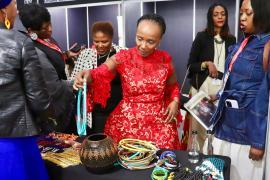
“These beads that we see, we see them in New York, and some of them [artists] are exploited, because they don't know the numbers and how much it is costing. They [buyers] go and buy beadwork in places like Ingwavuma [located in Umkhanyakude District Municipality, KwaZulu-Natal] for R2 and resell them in New York for $700. We need to make sure that in this platform, we cut that,” Mzamo said.
Standard Bank’s Executive Head of Strategic Partnerships, Lindeka Dzedze, reaffirmed the financial sector’s dedication to women's economic advancement.
“You are not alone. We are with you,” Dzedze told the businesswomen.
Tackling gender-based violence through economic inclusion
The speakers acknowledged the enduring legacy of the 1956 women’s march and the critical link between economic empowerment and the fight against gender-based violence and femicide (GBVF).
It was noted that GBVF thrives in environments of poverty, which is exacerbated by women’s exclusion from economic opportunities.
Pillar 5 of the National Strategic Plan (NSP) on Gender-Based Violence and Femicide aims to address the economic dimensions of GBVF, including economic dependence and abuse, by enabling women, including Lesbian, Gay, Bisexual, Transgender, Queer, Intersex and Asexual (LGBTQIA+) community to participate fully in the economy, - SAnews.gov.za


