


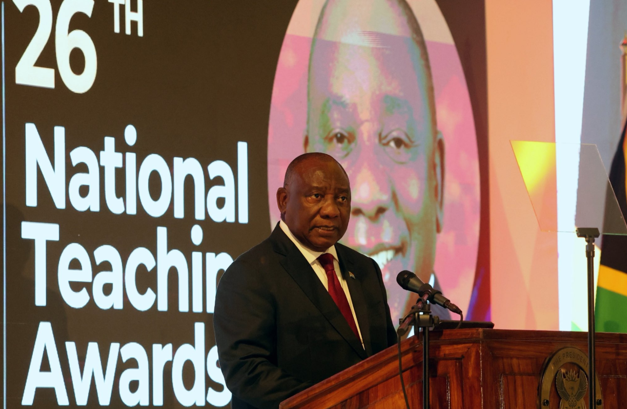
President Cyril Ramaphosa has called for greater investment in teachers and stronger support for educators, adding that better educational outcomes depend on creating the conditions in which teachers can focus on teaching.
Addressing the 26th National Teaching Awards at the Birchwood Hotel and Conference Centre in Ekurhuleni on Thursday, President Ramaphosa said teachers are central to transforming the education system and developing the country.
“If we want better educational outcomes, we must invest in better teaching. We must attract talented young people into the profession. We must support new teachers as they enter the classroom. And we must enable experienced teachers to continue developing their skills,” President Ramaphosa said.
The President said teaching must be restored to its rightful place as one of the most respected professions in society while government must provide safe and suitable school infrastructure, reduce unnecessary administrative burdens, strengthen professional development and ensure teachers receive the support they need throughout their careers.
Overcrowding, the protection of teaching time and acting firmly against violence, intimidation and disruption in schools were other important issues needing attention.
Teachers can change lives
Reflecting on his own schooling, President Ramaphosa recalled a teacher who had the greatest influence on his life - his former school principal, Mr Ntsandeni.
He said that as a learner, he was inquisitive and often challenged his teachers because he wanted to understand what he was being taught.
However, some of his teachers believed he should be expelled from school.
“My school principal, Mr Ntsandeni, thought differently. He saw something in me that others did not see. He intervened and protected me from being expelled,” the President said.
President Ramaphosa said Mr Ntsandeni understood that curiosity should not be punished but guided and encouraged, adding that the principal did more than keep me in school.
“He gave me the opportunity to continue learning, to develop and to become the person I am today,” he said.
The President said he would have wanted to present Mr Ntsandeni with a National Teaching Award had he still been alive.
“...not only for what he did for me, but for understanding what lies at the heart of teaching: seeing the promise in a young person and giving that promise the opportunity to flourish. That is what great teachers do,” he said.
Focus on learning outcomes
President Ramaphosa said the ultimate purpose of educational excellence was to improve the life chances of every learner.
He identified foundational literacy and numeracy as among the country’s foremost national priorities, warning that children who cannot read with understanding in the early years face greater difficulty throughout their education.
“The true measure of our progress is the child who learns to read for meaning, the young person who masters mathematics and science and the learner who leaves school with knowledge, confidence, dignity and real opportunities,” he said.
He called on every teacher, principal, district and education department to remain focused on improving learning outcomes.
The President also urged the education system to ensure that good practices are shared across provinces and schools.
Technology cannot replace teachers
President Ramaphosa said the rapid development of artificial intelligence and other digital technologies was changing how people work, communicate and learn and presented both opportunities and risks for education.
He said technology could give teachers access to new resources, assist with lesson preparation and support learners with different needs.
However, learners also needed to be equipped to distinguish knowledge from misinformation, think independently and use technology responsibly, safely and ethically.
“Artificial intelligence may be able to provide an answer, but a teacher helps a learner understand the question. Technology can transmit information, but it cannot replace the encouragement, discipline, empathy and human connection that a good teacher provides. The teacher remains essential.”
School safety
The President also called on educators and the wider education community to help address gender-based violence and femicide (GBVF), saying schools have a role to play in preventing violence before it happens.
President Ramaphosa said schools must not tolerate sexual harassment, abuse or exploitation by teachers, staff members or fellow learners.
He said education should help young people understand respect, dignity, equality and consent, while equipping them to resolve conflict without violence and build healthy interpersonal relationships.
“We must teach boys and young men that strength is not demonstrated through domination or abuse, but through respect, responsibility and self-control,” he said.
He called for stronger age-appropriate life-skills education from early childhood development through to high school, supported by teachers, parents, religious and traditional leaders, relatives and community elders.
Honouring educators
The National Teaching Awards were launched in 2000 by the late Minister of Education, Professor Kader Asmal, to acknowledge, appreciate and celebrate excellence in teaching.
President Ramaphosa said it was therefore fitting that educators who had devoted decades of their lives to developing South Africa’s children and communities were recognised through the Kader Asmal Lifetime Achievement Award.
The President said the awards demonstrate that excellence can be found across different phases of education, subjects and school communities.
More than 133 teachers participated in the national adjudication process in Gauteng earlier this month, with finalists recognised across various categories including Excellence in Grade R Teaching and Excellence in Teaching Mathematics (FET).
President Ramaphosa also highlighted the Minister’s Special Award, #MyTeacher, which allows learners to nominate teachers who have made a difference in their lives. He also congratulated all finalists and nominees, saying reaching the national adjudication stage was itself recognition of their contribution.
Teachers and the legacy of 1976
As South Africa marks the 50th anniversary of the 1976 Soweto Uprising, President Ramaphosa also reflected on the role teachers played during apartheid.
He said while the courage of the young people who rejected the Bantu Education system was rightly remembered, the contribution of teachers who provided guidance, knowledge and leadership during repression should also be recognised.
“We remember the teachers who were imprisoned, tortured, banned, exiled or killed for their role in the struggle. They understood that teaching is never only about what happens in a textbook. It is also about the values by which we live and the society we seek to build,” the President said.
President Ramaphosa said teachers continued to be looked upon for guidance, leadership and moral courage in democratic South Africa.
“South Africa’s future is being shaped in our classrooms. It is being shaped in the mind of every child who learns to read. It is being shaped in the confidence of every learner who discovers their ability. And it is being shaped by every teacher who refuses to give up on a child,” he said.
The President congratulated the award recipients and thanked educators for their contribution to the country.
This year’s awards were held under the theme: “Uniting for Excellence: Elevating Achievement, Empowering Educators to Shape South Africa’s Future.” – SAnews.gov.za


