


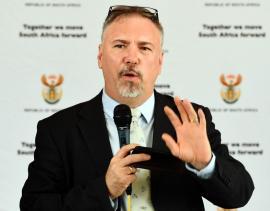
By Michael Currin
South Africa's democracy was forged through the courage, sacrifice and unwavering determination of those who believed in the ideals of freedom, equality and human dignity. The road to freedom was neither easy nor without immense pain. It demanded extraordinary resilience from generations who endured injustice, oppression and personal hardship in pursuit of a democratic South Africa where all people could enjoy equal rights and opportunities. The democratic gains achieved over the past three decades were hard-won and remain a shared national responsibility.
Preserving and advancing these gains requires ethical leadership that is guided by the principles of integrity, accountability and an unwavering commitment to serving the interests of the public. It is this kind of leadership that strengthens democratic institutions, inspires public confidence and ensures that government remains responsive to the needs of its people. Moreover, it is also the role of citizens to collaborate with government in ensuring that the values of democracy are upheld, communities remain actively engaged in shaping their future, and public institutions continue to serve as instruments for the advancement of society.
By embracing ethical leadership at every level of government, South Africa advances its vision of building a capable, ethical and developmental state that places the needs of its people at the centre of governance. Building such a state is a priority of the Seventh Administration and a constitutional imperative that underpins public administration. It is a state supported by strong democratic institutions that promote accountability, transparency and the protection of constitutional values.
These institutions, including Chapter 9 institutions such as the Public Protector, Auditor-General of South Africa and the South African Human Rights Commission, together with mechanisms such as commissions of inquiry, play a critical role in strengthening oversight and ensuring that public power is exercised responsibly. Ultimately, a capable, ethical and developmental state must be responsive to the needs of its people and committed to creating the conditions necessary for economic growth, job creation and an improved quality of life for all South Africans.
The success of a capable and developmental state relies heavily on having professional public servants. These are competent, accountable, ethical public servants who also possess the skills and expertise to plan and implement policies and monitor programmes that deliver meaningful outcomes for its citizens.
These principles are not abstract aspirations. They are rooted in South Africa’s constitutional framework and are binding for every sphere of government. The Constitution requires public servants to manage finances in a manner that is transparent and ensures value for money. Citizens have a right to know how public funds were allocated, how they were spent, what services were delivered, and who must be held accountable when commitments are not met.
Our democracy has several tools to ensure accountability, and one of these is the Public Finance Management Act (PFMA), which provides the legislative framework for the management of public finances across national and provincial government, as well as public entities. The PFMA promotes transparency, accountability and responsible financial management by requiring institutions to use public resources efficiently, effectively and in accordance with the law.
At the local government level, these principles are reinforced through the Municipal Finance Management Act (MFMA) and the Municipal Systems Act, which govern how municipalities and municipal entities manage public resources and deliver services to communities. Together, these legislative frameworks establish clear standards for budgeting, financial reporting, procurement, revenue management, oversight and the prevention of unauthorised, irregular, fruitless and wasteful expenditure. They are central to building ethical governance and protecting the integrity of South Africa’s democracy.
Compliance with legislation, however, does not on its own constitute capability. A municipality that submits reports on time but cannot provide reliable water services, maintain roads or pay legitimate suppliers cannot be regarded as fully functional. Equally, a municipality that completes a project through an unlawful procurement process cannot claim success. A capable state must deliver measurable results while upholding the law, protecting the public purse and ensuring that resources are used in the best interests of communities.
The recent actions by National Treasury to withhold municipal transfers from municipalities that failed to address governance and financial shortcomings serve as a reminder that protecting democracy requires ethical leadership and strong accountability systems. These interventions demonstrate that public resources are entrusted to government for the benefit of citizens and that leaders have a responsibility to ensure that these resources are managed responsibly, transparently and in accordance with the law.
While strong laws and accountability mechanisms are necessary to prevent the misuse of public resources, they cannot replace the need for leaders who act with integrity, take responsibility for their decisions and place the interests of communities above all else.
Ethical leadership is therefore fundamental to building the capable, ethical and developmental state envisioned in the National Development Plan (NDP) Vision 2030. The NDP recognises that a capable state requires strong institutions, professional public servants and leaders who are committed to accountability, transparency and effective service delivery. Policies and legislative frameworks provide the foundation for good governance, but it is ethical leadership that gives effect to these principles and ensures that government institutions serve their intended purpose.
Through ethical leadership, government can strengthen public trust, improve institutional performance and ensure that public resources are directed towards creating better outcomes for citizens. This is essential to preserving the gains of South Africa’s democracy and advancing a state that is responsive, accountable and committed to improving the quality of life of all South Africans.
*Currin is Deputy Director-General at the Government Communication and Information System


