


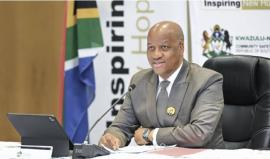
KwaZulu-Natal Premier Thamsanqa Ntuli has called for renewed commitment to peace, political tolerance and protection of the democratic process, as the province prepares for the 2026 Local Government Elections.
Premier Ntuli made the call at the Provincial Multi-Party Political Intervention Committee meeting on Tuesday.
The gathering brought together political parties and key institutions involved in safeguarding a peaceful electoral environment. It also provided a platform to strengthen dialogue, cooperation and political tolerance ahead of the elections.
The Electoral Commission has been conducting engagements with political parties, including traditional leaders, civil society, faith-based organisations, and other stakeholders in KwaZulu-Natal, as part of preparations for the elections on 4 November 2026.
In his address, Ntuli emphasised that the right to vote remains one of the fundamental pillars of South Africa’s democracy and has been secured through generations of sacrifice.
Ntuli also noted that the right to vote is inseparable from the right of citizens to make meaningful political choices, and for political parties to organise, campaign and contest elections freely.
“A democracy in which parties can disagree fiercely, yet peacefully, is a democracy that is alive. A democracy that silences its parties, or allows them to be intimidated, has begun to lose its soul.”
The Multi-Party Political Intervention Committee was established to bring political parties together, build trust, and provide a platform where political differences can be resolved through dialogue, rather than conflict.
He expressed concern that too often, the committee’s discussions are dominated by violence, intra-party conflict and killings, instead of electoral readiness, voter confidence and the strengthening of democratic participation.
Ntuli called for a clear distinction between legitimate political contestation and criminal conduct.
“What has been labelled ‘political violence’ is, in its essence, pure criminality. A person who kills, threatens or intimidates another is not advancing a political cause. That person is a criminal,” the Premier said.
Murder is murder, whatever the motive. Intimidation is intimidation, whatever the party card, he said.
Law-enforcement agencies have also been called on to deal with criminality without fear or favour, while the Premier also urged the committee to reclaim its broader mandate of protecting the integrity of elections and strengthening democracy.
He reiterated that the provincial government supports free and fair elections, to ensure that eligible voters can cast their ballots safely and secretly, and that political parties campaign freely and communicate their messages to communities.
Commitment to the electoral process
Ntuli also reaffirmed the provincial government’s commitment to working closely with the Electoral Commission and ensuring that provincial departments, municipalities and law-enforcement agencies provide the institutional support necessary for the electoral process to proceed without obstruction.
The Premier called for an inclusive approach to political dialogue, extending engagement to parties represented in the Provincial Legislature, as well as parties operating outside the Legislature and local government.
“Every party that contests in good faith, and within the law, has a rightful place in this conversation. No party is too big to be heard, and no party is too small to be respected,” the Premier said.
He called for sustained dialogue between government and political parties throughout the electoral cycle, arguing that trust developed during periods of stability can help prevent tensions from escalating during more difficult periods.
“Democracy does not sleep between elections.”
Traditional leaders, civil society and faith-based organisations were also identified as important partners in promoting political tolerance and peaceful democratic participation.
Premier Ntuli said Amakhosi have significant trust and moral authority within communities and can play an important role in ensuring that political parties reach communities without fear.
He also highlighted the contribution of civil society and faith communities in promoting dialogue, counselling communities during periods of tension and reinforcing the value of human life. – SAnews.gov.za


