


The National Prosecuting Authority (NPA) is intensifying the fight against organised crime by moving beyond prosecuting “foot soldiers” to targeting kingpins, syndicate leaders and those who control criminal networks.
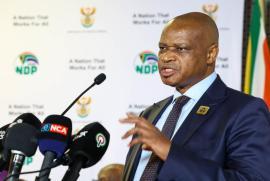
This according to National Director of Public Prosecutions (NDPP) Advocate Andy Mothibi who on Thursday briefed the media for the first time since taking office earlier this month.
“Organised crime remains a grave threat to our democracy and economy, especially when it targets essential infrastructure in sectors such as energy, rail, water and telecommunications.
“We are determined not to spend all our time prosecuting foot-soldiers; we are increasingly using financial investigation, digital forensics and intelligence-driven operations to identify and pursue the kingpins who direct these networks,” he emphasised.
Mothibi outlined the NPA strategy to dismantle organised crime operations and warned that state-embedded actors remain the government's “Achilles’ heel” in combating organised crime and corruption.
“The NPA’s Strategy against organised crime was signed off on 13 August 2024 and we are now in the process of intensifying implementation that will increasingly show impactful interventions and outcomes, through meaningful collaborations and more effective use of legislation,” he said.
The NDPP highlighted some of the successes the NPA has had in prosecuting organised crime syndicates, including:
- Sustaining the conviction rate of around 93 to 94% in organised crime prosecutions nationally, even while the number of these cases has grown.
- Conviction rates for essential infrastructure-related prosecutions remain in the mid-to-high 70s, at 77.4% in 2025/26, reflecting both the difficulty of dismantling complex supply chains and the progress being made with intelligence-driven investigations.
“Using racketeering provisions under POCA [Prevention of Organised Crime Act 121 of 1998], the NPA focuses on kingpins, syndicates, money laundering networks and enablers – accountants, lawyers and intermediaries,” he explained.
Other steps the NPA has taken to bolster the fight against organised crime include:
- Contributing to the development of the Transnational Organised Crime Strategy which is intended to be the country’s strategy against organised crime.
- NPA and SAPS developed a Stabilisation Plan which is a multi-dimensional interdepartmental organised crime approach to address the gang violence in the Western Cape. This plan is now being rolled out in other provinces.
- Establishing the Organised Crime Component (OCC)’s Firearm Desk.
“Firearms are central to organised crime in South Africa, and are primary instruments in gang violence, cash-in-transit heists, extortion networks, etc. A dedicated Firearms’ Desk would improve and strengthen coordination in addressing illegal firearms. If you remove the illegal firearm, you remove the instrument of organised violence.
“We have met with the National Commissioner of the South African Police Service [SAPS] to align the NPA and SAPS Strategies. Aligned strategy will, amongst others, enable collaboration between SAPS and NPA, identification of cases, Prosecutor-Guided Investigations, Asset Recoveries, Enrolment of cases and effective prosecution,” Mothibi said.
Pay back the money
Mothibi vowed that the NPA will not relent in “pursuing South African assets and fugitives from the law”.
In this regard, the prosecutorial body’s Asset Forfeiture Unit (AFU) has stepped up its work – obtaining some 2 397 freezing orders to the value of R13.8 billion, 3 220 confiscation and forfeiture orders to the value of R13 billion and has recovered some R6.5 billion since the conclusion of the previous Mutual Evaluation process of the Financial Action Task Force (FATF) in November 2019.
“We will not relent in pursuing South African assets and fugitives from the law. At an international level, while utilising the Interpol Red Notice, South Africa will participate in the Interpol Silver Notice Pilot which offers enhanced international search, trace and track mechanisms,” he said.
Other achievements include:
- R15 billion of funds frozen in the last five years, compared to the R16.2 billion frozen over the first 20 years.
- R8 billion confiscated and forfeited in the first 20 years and R5.4 billion in the last five years.
- R6.6 billion was recovered in the first 20 years and R6.6 billion in the last five years.
- R13 billion frozen in State Capture matters.
- The AFU has already exceeded five of the six annual targets in the current financial year.
“Asset recovery processes are critical as part of the fight against crime and corruption, by taking back the proceeds of crime. Further, asset forfeiture is one of the strongest indicators of Anti Money Laundering effectiveness under FATF standards.
“The NPA’s AFU is therefore central to FATF compliance,” the NDPP highlighted.
The NPA is also ramping up money laundering prosecution with at least 292 cases on court rolls involving more than 400 money laundering counts and a further 97 new prosecutions instituted between April 2025 and January 2026.
“The verdicts for the current financial year from April 2025 to January 2026 resulted in 91 verdicts, compared to 122 and 87 in the previous two financial years.
“The focus is on moving beyond ‘predicate offences’ and proving financial flows, concealment, and benefit from crime,” Mothibi said.
State Capture prosecutions
Prosecutions related to State Capture and the recommendations of the Zondo Commission are also gathering pace.
According to Mothibi, the AFU has restrained and preserved more than R14 billion in state-capture-related assets and recovered about R6.26 billion to date, “demonstrating that crime does not pay”.
The Investigating Directorate Against Corruption (IDAC) is also dealing with some 134 out of the 218 recommendations with 39 cases arising from the 134 recommendations.
The conviction and sentencing of former Parliamentarian Vincent Smith last week, in relation to the Bosasa matter is a “significant outcome that will culminate with the orange overalls that the public calls for in state capture related cases”.
“South Africa is one of the few countries in the world that is prosecuting former ministers, senior officials, chief executives and multinational companies for serious corruption – and we are seeing tangible financial returns through asset recovery and corporate settlements,” the NDPP noted.
On the IDAC’s state capture work, the Digital Evidence Unit (DEU) is a game changer for work related to recommendations and beyond.
“The DEU is one of the most important capacity and capability-building initiatives that is designed to support the work of the IDAC, arising especially out of the very large volumes of electronic data from the State Capture Commission.
“This is an aspect of work that continues to hold investigations back within law enforcement and having this capability is a game changer in the fight against complex corruption.
“Having this kind of capacity provides IDAC with the ability to move faster and smarter in digital forensics. The IDAC is currently dealing with 13 matters in the DEU,” the NDPP revealed.
Without fear or favour
Mothibi acknowledged that South Africans are “rightly impatient for more visible accountability, especially for corruption and violent crime”.
However, he noted that the NPA is an institution that has been “fundamentally rebuilt” following years of being blunted during the state capture years.
“The figures we present today show an institution that has not only survived the state-capture decade but has been fundamentally rebuilt: conviction rates remain high, high-impact prosecutions are being pursued, and billions are being recovered for the public. But we know this is not enough.
“We therefore renew our pledge to prosecute without fear, favour or prejudice, to protect the vulnerable, to safeguard our critical infrastructure and economy, and to do so in a way that honours the Constitution, strengthens the rule of law and meets public expectations.
“We also commit to holding more regular briefings to the public to provide updates on the organisation’s strategy and performance information, through traditional media but also increasingly, through our digital communication platforms,” he concluded. – SAnews.gov.za


