


Deputy Minister of Women, Youth and Persons with Disabilities Steve Letsike has warned that the constitutional promise of equality will remain unfulfilled if deaf South Africans are unable to access education, justice, healthcare, or participate in the economic opportunities in their own language.
Letsike was speaking on Tuesday, as the country joins the Globe in observing International Day of Sign Language (IDSL)
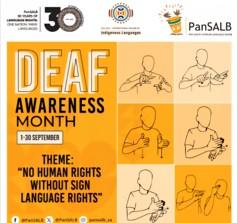
Observed globally on 23 September, IDSL was proclaimed by the United Nations to highlight the importance of sign languages in realising the human rights of deaf people worldwide. This year, the day is observed under the theme: “No Human Rights Without Sign Language Rights.”
Speaking at the celebration event, hosted by the Government Communication and Information System (GCIS) in partnership with Sports, Arts and Culture and the PanSALB, in Pretoria, Letsike stressed that the theme is not a slogan to be applauded and forgotten, but “a profound truth [and] a declaration of what democracy means in practice.”
“It challenges all South Africans to ensure that the recognition of South African Sign Language (SASL) as our 12th official language is matched by implementation in every classroom, every clinic, every court, every workplace, and every community space,” Letsike said.
She stressed that deaf South Africans are not invisible or marginalised, but citizens with equal rights and equal claims to justice and opportunity.
The Deputy Minister argued that language is not simply a tool of communication, but a vessel of belonging.
“It is the bridge into education, the pathway into employment, the medium through which one takes part in democracy, [and] the foundation upon which identity and dignity are built.
“Denying South African Sign Language is not simply denying a form of expression; it is denying access to the fullness of citizenship itself. It is denying democracy. It is denying humanity,” she warned.
Letsike also highlighted that while South Africa is home to nearly 600 000 deaf people, exclusion remains the daily reality.
According to World Health Organisation (WHO) World Report on Hearing (WRH) Context in South Africa, as many as four million South Africans live with significant hearing loss, and of these about 600 000 are active users of South African Sign Language (SASL).
Letsike said this number places the deaf community not as a “marginal fragment” of the population, but as a significant portion whose lives and futures matter to the destiny of our country.
She raised particular concern over the state of education for deaf learners, noting that studies show nine out of 10 teachers of deaf learners have no knowledge of SASL.
“Teacher training programmes are not structured to require proficiency in the very language their learners depend upon for education. Imagine the injustice of expecting children to flourish in classrooms where their teachers cannot communicate with them. This is not simply a barrier to learning, it is a denial of equality itself,” Letsike said.
According to the Deputy Minister, the implementation of SASL as a language of learning and teaching has been undermined by shortages of trained teachers, insufficient curriculum support, inadequate resources, and vast disparities between well-resourced and under-resourced schools.
She also highlighted that between 90% and 95% of deaf children are born to hearing parents who do not use SASL at home.
“Many of these children arrive at school already facing delayed language development, not because they lack potential, but because their earliest years were deprived of accessible communication.
“This delay follows them for life. It shapes their educational trajectory, limits their opportunities, and too often undermines their confidence and sense of self. And we must ask: what does it say about our collective humanity when we knowingly allow such deprivation to continue?” she said.
She called for stronger implementation of existing legislation and policy frameworks, including the White Paper on the Rights of Persons with Disabilities, the Disability Rights Bill, the recognition of SASL as an official language, and South Africa’s ratification of the UN Convention on the Rights of Persons with Disabilities.
“These frameworks must travel from paper into practice. Equality is indivisible, justice is indivisible, [and] human rights are indivisible. As we reflect nationally, we must also recognise our global responsibilities. South Africa holds the G20 Presidency for the first time in history.” – SAnews.gov.za


