


Government has reaffirmed its commitment to ending Gender-Based Violence and Femicide (GBVF) through the operationalisation of the National Council on GBVF, which will provide a permanent, statutory and multisectoral mechanism to coordinate, monitor and strengthen the country’s response to the scourge.
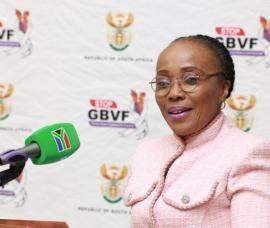
Minister in the Presidency for Women, Youth and Persons with Disabilities Sindisiwe Chikunga said the inaugural meeting of the National Council on Monday, marked a defining moment in South Africa’s ongoing fight against GBVF and demonstrated government’s determination to translate constitutional rights into lived realities for women and girls.
Addressing the media on progress made in operationalising the National Council on Gender-Based Violence and Femicide (GBVF Council), Chikunga said the Council’s establishment is more than the creation of another public institution.
“This is not simply the establishment of another public institution. It is the institutionalisation of a national commitment to eradicate one of the gravest violations of human rights in democratic South Africa,” Chikunga said.
The National Council is established in terms of the National Council on Gender-Based Violence and Femicide Act, 2024 (Act No. 9 of 2024), following years of advocacy by women’s movements, civil society organisations, faith communities, labour, traditional leaders, business, and government.
Chikunga noted that the Council stands as a permanent, statutory and multisectoral mechanism through which South Africa will coordinate, monitor and strengthen its response to GBVF.
“It embodies the collective determination of the nation to ensure that women, children and vulnerable persons can live free from fear, abuse, violence and discrimination.”
She said the Council’s establishment gives practical expression to the National Strategic Plan on GBVF 2020-2030, which recognises the need for a coordinated institutional mechanism capable of driving a national response beyond electoral cycles and departmental boundaries.
The Council includes representatives from government, women’s rights organisations, survivor advocacy groups, community-based organisations, faith-based organisations, disability rights organisations, youth formations, Lesbian, Gay, Bisexual, Transgender, Queer/Questioning, Intersex, and Asexual (LGBTQIA+) advocacy structures, research and academic institutions, traditional and community leadership formations, business, labour and development partners.
Chikunga stressed that the Council was not merely established to provide sectoral representation, but to serve the Constitution, the Act, women, girl children, survivors of GBVF and the people of South Africa.
“Government representation ensures policy coherence, intergovernmental coordination and implementation across the state machinery. Civil society serves as the conscience of the national response and ensures that women, girl children, survivors and communities' experiences remain at the centre of decision-making.
“The Act itself recognises the indispensable role of the private sector in combating GBVF. The private sector contributes resources, innovation, workplace interventions, economic empowerment initiatives and strategic partnerships necessary to sustain a comprehensive national response,” Chikunga said.
Scale of GBVF
Chikunga also noted that the Council begins its work against a backdrop of compelling evidence on the scale of GBVF in the country.
The Human Sciences Research Council’s First South African National Gender-Based Violence Prevalence Study, released in November 2024, found that approximately 7.3 million women aged 18 years and older have experienced physical violence during their lifetime, while more than 2.15 million have experienced sexual violence.
The study also found that women with disabilities face particularly high levels of vulnerability, with the prevalence of sexual violence by a lifetime partner twice as high among women with disabilities compared with women without disabilities.
The latest South African Police Service (SAPS) Crime Statistics also recorded 50 511 GBVF cases during the first quarter of the 2026/27 financial year, with 30 736 resulting in arrests or referrals to the National Prosecuting Authority.
“These are not just statistics. These are South African women, daughters, sisters and girl children. Above all, they are South African citizens whose constitutional rights have been violated.
“The prevalence study alongside the SAPS statistics support President [Cyril] Ramaphosa’s position when he affirmed that we are in a crisis, and that this crisis demands we step up measures to protect women and girls and advance their rights,” Chikunga said.
Priorities
As part of its initial priorities, the National Council will work towards concluding a Shareholder Compact, which Chikunga described as an important accountability mechanism that will define what success looks like and how it will be measured.
The Council will also develop a comprehensive costing framework to identify the resources needed to combat GBVF, address gaps and build a compelling national investment case.
Chikunga said good governance, ethical leadership, transparency and fiduciary responsibility will also be central to the Council’s work. – SAnews.gov.za


