


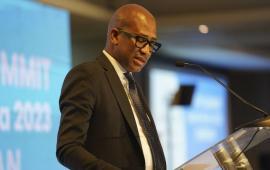
Deputy Minister in the Presidency Kenny Morolong has urged the youth to actively participate in building the green economy of the future.
The Minister addressed the closing ceremony of the 11th Green Youth Indaba held at Sun City in the North West on Friday.
The two-day indaba was held to bring awareness to the youth regarding the opportunities available to them within the green economy.
“As we conclude the 11th Green Youth Indaba, we do so inspired by what we have witnessed over the past two days and challenged by the responsibility that now rests upon all of us.
“This gathering has shown that young South Africans are not waiting for the future to arrive; they are already building it through innovation, enterprise, research, activism and service.
“This year’s theme, From Youth Innovation to Green Enterprise and Economic Impact, speaks directly to the task of our time: to convert ideas into practical solutions, and to convert those solutions into enterprises, jobs and lasting economic value,” the deputy minister said.
Morolong noted that over the course of the indaba, participants explored solutions in areas including renewable energy, water security and circular economy development.
They also heard from policymakers, investors, researchers, entrepreneurs and from young people who are already developing practical solutions to real-world challenges.
“What has become abundantly clear is that South Africa does not suffer from a shortage of talent.
“Our greatest challenge is ensuring that innovation is transformed into enterprise, that enterprise attracts investment and that investment creates jobs, incomes and sustainable economic opportunities,” the deputy minister said.
Milestones of Freedom
Morolong drew comparisons between the Green Youth Indaba and the Milestones of Freedom campaign launched President Cyril Ramaphosa last week under the theme: Honouring the Past. Delivering the Future.
The campaign is aimed at reflecting on South Africa’s journey to freedom and the interventions government has made to build a capable State.
“We would like to repeat that message here today, because the story of freedom is also the story of youth courage, youth imagination and youth action.
“The milestones we commemorate are not monuments frozen in time. They are instructions to the present generation on how to use today to build tomorrow,” he stated.
The campaign also commemorates the 30th anniversary of the adoption of the Constitution, the 50th anniversary of the 1976 youth uprisings, the 70th anniversary of the 1956 Women’s March and the 60th anniversary of the forced removals from District Six.
“Each of these moments teaches us something important: that freedom is defended by courage, deepened by organisation and made meaningful through delivery.
“The Constitution reminds us that every young person has dignity, rights and responsibilities. The youth of 1976 remind us that young people can change the direction of history when they refuse to accept injustice.
“The women of 1956 remind us that organised communities can confront systems that appear immovable [and] District Six reminds us that development without justice destroys lives, and that rebuilding must always restore belonging, opportunity and dignity,” Morolong emphasised.
The green economy is here
Turning back to the business of the day, Morolong noted that the indaba has grown into “one of South Africa’s most important youth development and green economy platforms”, connecting young people with “opportunities, partnerships, knowledge and networks”.
“The significance of this gathering extends beyond sustainability.
“It speaks directly to one of the central priorities of the Government of National Unity: creating faster economic growth, creating jobs and expanding opportunities for all South Africans, especially young people.
“The Medium-Term Development Plan 2024–2029 recognises that South Africa's long-term success depends on building an economy that is inclusive, competitive, innovative and capable of delivering measurable improvements in people's lives,” the deputy minister said.
He added that at the centre of this plan is the youth of South Africa.
“Every economic reform we undertake, every infrastructure programme we implement, every industrial policy intervention we introduce, and every investment we mobilise must ultimately expand opportunity for the next generation.
“That is why youth development cannot be treated as a separate programme. It must be integrated into every aspect of economic transformation,” Morolong highlighted.
He added that young people must lead as innovators, entrepreneurs, industrialists, employers and active builders of the economy of the future.
“In renewable energy, young people can become installers, electricians, maintenance technicians, energy auditors and green construction entrepreneurs. In agriculture, they can work across the full value chain from production to processing, packaging, logistics, irrigation, exports and agribusiness management.
“In water, they can build solutions for leak detection, treatment, conservation and infrastructure maintenance.
“In the circular economy, waste can become value through recycling, plastics beneficiation, e-waste recovery and circular manufacturing. In the digital economy, coding, data analytics, artificial intelligence, digital platforms and advanced manufacturing can help young people solve old problems in new ways,” Morolong said.
He encouraged the youth to use government programmes aimed at supporting enterprise development, skills development and innovation.
These structures include the National Youth Development Agency, the Small Enterprise Development and Finance Agency, Sector Education and Training Authorities, TVET colleges, universities, innovation hubs and business incubators. – SAnews.gov.za


