

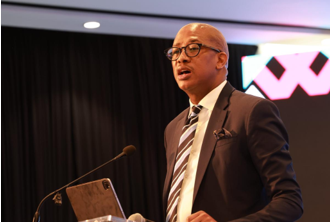
Deputy Minister in the Presidency Kenny Morolong has called for renewed commitment to multilateral cooperation, saying international institutions must demonstrate their ability to improve people’s lives amid growing global inequality, conflicts and economic uncertainty.
Addressing the United Nations Day 2026 commemoration in Pretoria on Tuesday, Morolong said restoring trust in multilateralism requires more than defending existing institutions but demonstrating that international cooperation could deliver tangible benefits for people across the world.
“This year's theme: 'Restoring Trust, Managing Transformation', a United Nations that delivers for all, could hardly be more timely,” Morolong said.
Morolong said the world was grappling with armed conflicts, widening inequality, climate-related disasters, mounting debt burdens and rapid technological change, all of which tested the effectiveness of international institutions.
“Yet, amid these uncertainties, South Africa's conviction remain unchanged. Multilateralism is not the problem. Multilateralism is the solution,” he said.
The commemoration, co-hosted by the Department of International Relations and Cooperation (DIRCO) and the United Nations Country Team, took place under the theme Restoring Trust and delivering shared prosperity together in a changing world.
United Nations Day is observed annually on 24 October, marking the entry into force of the UN Charter in 1945.
Morolong said international cooperation must help address global inequality, create economic opportunities, strengthen climate resilience, support peace and expand opportunities for young people.
Reflecting on the United Nations’ contribution over the past 81 years, Morolong said the organisation had supported peace and security, economic and social development, human rights, humanitarian assistance and international cooperation.
He noted that South Africa’s own history demonstrated the value of international solidarity, recalling the role played by the United Nations in condemning apartheid.
“Sixty years ago, this very organisation condemned apartheid as a crime against humanity,” Morolong said.
He said democratic South Africa’s foreign policy remained anchored in Ubuntu, international law, dialogue and multilateralism, recognising that the country’s security, prosperity and development were inseparable from those of the continent and the wider world.
Morolong reaffirmed South Africa’s support for a rules-based international order grounded in the UN Charter, emphasising that all states, regardless of their size or power, must adhere to international law.
“As we have consistently maintained, might does not make right. International law must apply equally to all nations, large and small,” he said.
He added that lasting peace could not be achieved through military means alone, but required sustainable development, accountable governance, respect for human rights and diplomatic solutions to conflicts.
Morolong also highlighted the need to address structural inequalities in the global economy, including unsustainable debt burdens and limited access to development finance, which continue to constrain developing countries’ ability to invest in infrastructure, education, healthcare and economic transformation.
He said South Africa supported international efforts to ensure that the benefits of globalisation were more fairly shared, noting that the country had joined Brazil, Norway and Spain in calling for the establishment of an international panel on inequality during the 81st session of the UN General Assembly.
On climate change, Morolong called for stronger international action on resilience, adaptation and predictable financing for a just energy transition, stressing that developing countries were often the most vulnerable to climate impacts despite contributing the least to global emissions.
He further called for Africa to play a meaningful role in shaping global standards and institutions governing artificial intelligence and other emerging technologies.
“The future of multilateralism will ultimately be judged not only by the declarations we adopt, but by the opportunities we create for future generations,” he said.
Morolong said reforming the United Nations was essential to ensure the organisation remained representative, effective and responsive to the needs of member states and their people.
He highlighted Africa’s continued underrepresentation in key international decision-making structures, despite the continent being home to nearly one-fifth of humanity and more than a quarter of UN member states.
South Africa, he said, continued to support the Ezulwini Consensus and the call for permanent African representation on the UN Security Council, with all the prerogatives of permanent membership.
A stronger United Nations, he said, must reflect contemporary realities and ensure that all regions had a meaningful voice in shaping global decisions.
Meanwhile, UN Resident Coordinator in South Africa, Nelson Muffuh, said the commemoration provided an opportunity to reflect on the future of multilateral cooperation and whether international institutions were delivering meaningful improvements in people’s lives.
“The answer to frustration with multilateralism is not less multilateral cooperation; it is better multilateralism, more representative, more effective, more responsive, and better able to deliver people in the decades to come,” Muffuh said.
He said communities continued to face unemployment, poverty, inequality, pressure on public services and uncertainty about the future, requiring practical and responsive solutions.
Muffuh also highlighted the importance of effective migration governance, saying orderly migration management must be accompanied by respect for human rights and human dignity, including appropriate protection for refugees and asylum seekers under South African law and the country’s international obligations.
“These objectives are not in competition,” he said, adding that migration management, the protection of rights and stronger social cohesion could reinforce public confidence when concerns were addressed through capable institutions, dialogue and lawful processes.
Muffuh echoed calls for reform of global governance structures, including the UN Security Council and the international financial architecture, arguing that a stronger African voice in international decision-making was essential to restoring trust.
He also highlighted the partnership between South Africa and the United Nations, including the United Nations Cooperation Framework for 2026 to 2030, which supports national priorities centred on inclusive economic growth, job creation, social inclusion, accountable governance and resilience.
Both speakers called for renewed international cooperation to address shared challenges and build a more equitable, peaceful and sustainable future. – SAnews.gov.za


