


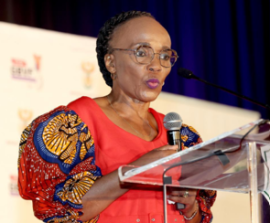
Minister in the Presidency for Women, Youth and Persons with Disabilities, Dr Sindisiwe Chikunga, has called on South Africa’s media, film, advertising and entertainment sectors to use their immense influence to help shift the country’s cultural norms and accelerate the fight against gender-based violence and femicide (GBVF).
The Minister was delivering the keynote address at the national 2025 launch of the 16 Days of Activism for No Violence against Women and Children campaign at Gallagher Convention Centre on Tuesday.
“Whether through drama, current affairs or advertising, this sector has the influence to flip the script: to end a culture that normalises violence, and replace it with one that normalises dignity, consent, care and accountability,” Chikunga said.
The Minister said the 16 Days period must be more than an annual symbol; it must drive accountability, urgency and collective action.
The campaign is being held under the theme: “Letsema: Men, Women, Boys and Girls Working Together to End GBVF”, with a sub-theme emphasising the role of arts, film and media in preventing violence.
Chikunga noted that Saturday’s G20 Leaders’ Declaration adopted in Johannesburg reaffirmed a global commitment to ending violence against women and girls, and expanding access to economic opportunities.
“South Africa led that consensus. Our task now is to implement it boldly at home,” she said.
A crisis measured in lives, not numbers
Drawing on major research findings, including the HSRC [Human Sciences Research Council]-led GBVF Prevalence Study, Chikunga painted a stark picture of women’s lived realities:
- 33.1% of women and girls have experienced physical violence in their lifetime.
- 27% have experienced physical or sexual violence by a non-partner since age 15.
- 7.9% of ever-partnered women have survived sexual violence from a partner.
- 20.5% of ever-partnered men admitted to perpetrating physical or sexual intimate partner violence.
South African Police Service (SAPS) data continue to show tens of thousands of sexual offences reported annually, with spikes on weekends, paydays and communities with high concentrations of liquor outlets.
She warned that harmful media portrayals from sensationalist reporting to glamorised violent masculinity, silently reinforce norms that put women and girls at risk.
“Today’s summit focuses on the media, entertainment and film industries because narrative is infrastructure. History tells us that stories shape what society sees as normal, possible and acceptable. They influence beliefs, law-making, relationships, markets, and everyday behaviour,” she said.
The Minister officially launched the Five-Year Review of the National Strategic Plan (NSP) on GBVF, noting progress in legislation, justice-system reforms and coordination across departments and civil society.
South Africa now has 66 Thuthuzela Care Centres, 1 100+ victim-friendly rooms, 1 200+ dedicated GBVF desks in SAPS and cleared DNA backlog, with over 52 000 cases prioritised.
More than 40 district and municipal GBVF Rapid Response Teams have been established, while the GBVF Response Fund continues supporting shelters and prevention programmes.
But Chikunga cautioned that efforts still fall short of what a national crisis requires.
“The President’s decision to classify GBVF as a national crisis must be a turning point: from uneven gains to emergency-level action, funding and coordination in every sphere of society. The question before us today is how the media, entertainment and film sectors will help us close that gap,” she said.
A direct challenge to Media, Film and Advertising leaders
Chikunga issued one of her strongest calls yet to South Africa’s storytellers, editors, producers, broadcasters, actors, writers, influencers and advertisers to harness their platforms to shift social norms.
“Only you, the storytellers of this country can change the cultural climate in which violence becomes thinkable,” she said.
The Minister called for an industry-wide GBVF Portrayal and Editorial Code, stricter watershed and advert placement, harm assessments for high-impact content, safe workplaces with real whistle-blower protections, zero tolerance for digital abuse, deepfakes and non-consensual imagery and storylines that normalise consent, dignity, healthy masculinity and accountability.
A single storyline, she said, often shifts public opinion faster than policy.
“If we change what we make, we will change what we mirror. And if we change what we mirror, we will change what we become. Let us rewrite the script and end GBVF,” she said.
Chikunga closed with a powerful appeal to society at large, including faith leaders, teachers, men, boys and parents, to model dignity and accountability in every sphere of life.
She also honoured survivors, saying government’s success would be measured by whether their path to justice becomes shorter, kinder and fully supported.
The Minister officially declared the 2025 16 Days of Activism campaign open and launched the five-year review of the National Strategic Plan on GBVF. – SAnews.gov.za


