


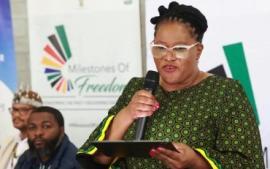
The struggle for South African women’s freedom stretches far beyond the historic 1956 march to the Union Buildings, with the story of Sarah Baartman offering a stark reminder of the colonial violence and dehumanisation from which women had to be liberated, Eastern Cape MEC for Economic Development, Environmental Affairs and Tourism Nonkqubela Pieters says.
Speaking at the Eastern Cape leg of the Milestones of Freedom programme during Women’s Month, Pieters placed Baartman’s story at the centre of the country’s long journey towards women’s emancipation, arguing that the history of colonial conquest must be confronted alongside the struggle against apartheid.
Pieters said the women who marched on 9 August 1956 were not simply demanding changes to apartheid legislation, but were fighting for “total liberation”.
The marchers, including Lilian Ngoyi, Helen Joseph, Rahima Moosa and Sophia Williams-De Bruyn, had challenged a system that sought to restrict the rights and freedom of Black South African women, she said.
But, she argued that the history of women’s oppression in South Africa began well before apartheid was formally established.
“To understand the full scope of what South African women were emancipated from - and to grasp the scale of what we must still build - we must look deeper into the historical architecture of colonial conquest,” Pieters said.
That history, she said, could not be told without confronting the story of Sarah Baartman, a Khoikhoi woman born in the Eastern Cape in the 1780s.
Baartman was taken to Europe under coercive circumstances and exhibited publicly in London and Paris, where she was presented as an exotic spectacle. After her death, her remains were subjected to further examination and displayed in France for decades.
For the MEC, Baartman’s experience represented the intersection of racial, gender and class oppression inflicted on African women under colonial rule.
“To speak of Sarah Baartman is to confront the most acute historical manifestation of imperialist dehumanization, gender-based degradation, and racial supremacy,” she said.
Baartman’s remains were eventually returned to South Africa following negotiations between the democratic government and France. She was buried in Hankey in the Eastern Cape on Women’s Day in 2002.
Pieters described Baartman's repatriation as more than an act of remembrance, saying it represented the democratic state’s commitment to restoring the dignity and humanity denied to her under colonial rule.
Her burial, she said, was a declaration that women in democratic South Africa would no longer be treated as property or second-class citizens.
Pieters then drew a direct line between Baartman’s history and the 1956 women’s march, saying both moments formed part of a much longer struggle for women’s dignity and self-determination.
However, the MEC warned that the attainment of political freedom in 1994 had not brought the struggle to an end.
Despite South Africa’s constitutional and legislative advances on gender equality, women continue to face poverty, unemployment, inequality and gender-based violence, she said.
Pieters particularly highlighted economic dependence as a continuing threat to women’s freedom, arguing that women who lack financial independence can face greater difficulty escaping abusive relationships.
“The fight against GBVF is inextricably linked to the fight for economic independence,” Pieters said.
The address therefore positioned economic empowerment as the next stage of the historical struggle, with the government calling for greater access to capital, land, skills, procurement opportunities and ownership for women.
She also called on the private sector to open supply chains to women-owned businesses and urged government to prepare women and girls for emerging sectors such as technology, artificial intelligence, renewable energy and commercial agriculture.
The significance of Women’s Month lay not only in commemorating the women who fought apartheid, but in recognising the much longer history of oppression that preceded it.
The journey from Baartman’s forced exhibition in Europe to women occupying positions in Parliament, government, business and science demonstrated how far South Africa had travelled, the MEC said.
Pieters cautioned, however, that the country could not claim complete victory while women continued to face economic exclusion and violence.
“Let us honour the marchers of 1956 not just with speeches, but with capital, land, skills, and absolute protection,” the MEC said. – SAnews.gov.za


