


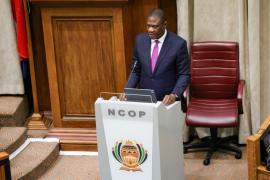
Deputy President Paul Mashatile has addressed the mounting water crisis facing South African municipalities, revealing a multifaceted approach to tackle systemic issues plaguing water and sanitation services nationwide.
Speaking in the National Council of Provinces (NCOP) on Tuesday, Deputy President cited a report from the Department of Water and Sanitation, which shows a significant decline in the capacity of municipal water delivery.
As a result, national reliability has dropped to only 68%, and the quality of water in 60% of water supply systems is deteriorating.
Mashatile said this crisis stems from a combination of factors, including poor governance, lack of technical capacity, inadequate infrastructure investments, and financial mismanagement.
“I must highlight that government is taking decisive steps to resolve the systemic issues that continue to hinder the reliable provision of water and sanitation services to local communities.”
Through the Water Task Team, he said the government is tackling water security challenges by improving infrastructure, reforming institutions and expediting project management in a coordinated approach.
The South Africa National Water and Sanitation Indaba held in March this year proposed key interventions aimed at addressing the challenges of water provision and continuous disintegration of critical water infrastructure, amongst others.
Key recommendations included increased investments through financing options and ensuring the financial viability of the sector.
In addition, the Department of Water and Sanitation (DWS) has established a Water Partnership Office housed at the Development Bank of Southern Africa (DBSA) to help municipalities prepare projects for private sector investment.
“Through this office, the department is already implementing several public-private partnerships, such as the Olifants River Management Model Programme.”
According to the Deputy President, this programme has been introduced to address the bulk water needs, particularly in Limpopo, to promote economic development and ensure the delivery of bulk raw water to municipalities.
He explained that this model is based on a 50/50 public-private partnership.
In this arrangement, 50% of the project’s cost is contributed by the mining companies, while the remaining 50% is funded by the government through water infrastructure grants and the budget facility for infrastructure.
He announced that the DWS, Water Boards and water service authorities are working to increase collaboration with the Infrastructure Fund to put in place more blended finance water projects.
He also touched on the projects in major cities like Johannesburg and Cape Town, the Vaal Gamagara Water Supply Scheme in the Northern Cape, Lesotho Highlands and uMkhomazi Water Projects.
In combating corruption, the country’s second-in-command acknowledged the significant challenge of water tanker corruption and infrastructure vandalism.
“National Treasury has issued a circular cautioning municipalities against long-term reliance on water tankers, which can only be used as temporary emergency measures.”
The Deputy President stressed the importance of collaborative approaches, calling for increased community involvement and a culture of reporting suspicious activities to expose criminal networks within the water sector.
“As government, we call for increased community participation in protecting critical infrastructure. We also urge communities to report suspicious activities and embrace the culture of whistleblowing to expose criminal networks and corruption within the water sector.”
He stated that the government remains committed to addressing these challenges, viewing water infrastructure as a critical national priority.
“Water is life. Government remains committed to improving the provision of a reliable water supply, especially to township and rural communities.”
Confronting GBVF head-on
Meanwhile, as South Africa marks the 16 Days of Activism for No Violence against Women and Children Campaign, he said the country refuses to accept gender-based violence and femicide (GBVF) as normal.
“To fight GBVF effectively, we need to continually raise awareness, improve coordination and mobilise resources among our institutions. All of us must be activists against GBVF starting in our homes, communities, work and in leadership roles.
“We must declare that this scourge will not persist under our watch,” he added.
The Deputy President was responding to questions from NCOP delegates representing their provinces regarding his delegated responsibilities. – SAnews.gov.za


