


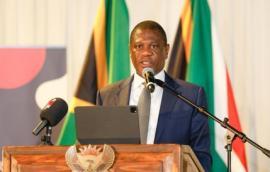
Deputy President Paul Mashatile has highlighted the critical role of small and medium enterprises (SMEs) as crucial contributors to economic development and job creation.
“Speaking of job creation, the SMEs are significant contributors to economic development and job creation globally. We can attribute their relevance in reducing unemployment to their ability to react swiftly to market changes,“ he said on Thursday.
The country’s second-in-command was delivering his closing remarks during the inaugural Global SME Ministerial Meeting at the Birchwood Hotel & OR Tambo Conference Centre, Boksburg, Gauteng.
The Deputy President has called for prioritising the development of SMEs to create jobs and enhance income for youth, women, and marginalised groups.
He stressed the need for a commitment to resolving regulatory bottlenecks related to cross-border trade and investment, urging participants to focus on local value creation and expanding local supply chain opportunities for micro, small, and medium enterprises (MSMEs).
“This can be achieved by ensuring that the Green Economy Transition is supported by clear green industrialisation policies,” he added.
The Global SME Ministerial Meeting served as a vital platform for fostering partnerships and setting a collaborative agenda aimed at propelling SMEs towards a more sustainable, inclusive, and prosperous future.
The meeting concluded with a renewed commitment to support SMEs worldwide, as leaders gathered to address the challenges and opportunities they face in a rapidly changing global landscape.
“This inaugural Global SME Ministerial Meeting could not have come at a better time,” he told the attendees.
The discussions revolved around key themes such as enhancing access to finance, promoting digital transformation, and facilitating green transitions within the SME sector.
Mashatile expressed optimism, highlighting the potential for collaboration and shared goals to unlock significant opportunities for SMEs globally.
He also took the time to commend the role of the United Nations (UN) in fostering multilateral cooperation during a time when unilateralism is challenging the sustainability of nations.
“This relationship is critical in this challenging period of abrupt shifts towards unilateralism, which jeopardise the sustainability of our respective countries and the world,” Mashatile added.
The Deputy President touched on the “Call to Action” that emerged from the meeting, which reaffirmed support for vital multilateral initiatives, including the Sustainable Development Goals, the Paris Agreement on Climate Change, the Pact for the Future, the Global Digital Compact, the Declaration on Future Generations, the Paris Agreement on Climate Change, and Group of 20 (G20).
He stressed South Africa’s position as the G20 Presidency, under the theme of ‘Solidarity, Equality, Sustainability,’ focused on championing developmental issues, particularly in Africa.
As the G20 Leaders’ Summit approaches, Deputy President Mashatile told attendees that the meeting was instrumental in gathering ministers from the continent and the Global South to exchange insights relevant to the larger G20 agenda.
“We have heard your voices and will ensure that we champion the issues you have raised in the broader G20 processes and the G20 Leaders’ Summit in November,” he said.
In addition, a meeting of Trade Promotion Organisations took place alongside the Ministerial Meeting, where participants discussed the impacts of trade protectionism and disruptions to global supply chains.
The Deputy President urged governments to enhance trade and economic diplomacy, emphasising the importance of multilateral trade agreements in bolstering economic growth.
“We must enhance our capabilities to strengthen trade and economic diplomacy, allowing ourselves to engage more effectively in both bilateral and multilateral trade agreements,” Mashatile stated.
South Africa’s efforts to strengthen regional trade through agreements like the Southern African Customs Union and the African Continental Free Trade Area (AfCFTA) were highlighted as pivotal steps towards unlocking Africa’s economic potential.
“The Free Trade Area Agreement can significantly enhance Africa’s entrepreneurial landscape by reducing trade barriers and increasing market access, enabling youth to expand businesses, innovate products and services, and seize untapped opportunities within the continent.” – SAnews.gov.za


