


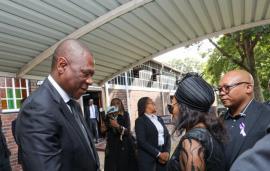
Deputy President Paul Mashatile has paid tribute to late ANC stalwart and intellectual Magashe Titus Mafolo, describing him as a principled leader whose life’s work helped shape South Africa’s democratic governance, intellectual thought and African identity.
The Deputy President was delivering the eulogy at the funeral service of Magashe Titus Mafolo, held in Irene, Pretoria, on Friday.
Mashatile thanked the Mafolo family for allowing government and society to honour a “son of the soil”, whose contributions transcended politics and touched communities across the country.
“Pheli (Atteridgeville) and South Africa have lost a gem, a son born in January 1956 in Sekhukhune and raised in Atteridgeville, Pretoria, Mafolo was deeply committed to the anti-apartheid struggle from a young age.
“Trained as a journalist, he was active in the United Democratic Front, a part of his activism being having to endure imprisonment, torture, and banning orders by the apartheid government, and not once did he waver in his commitment to freedom, justice, and equality,” the Deputy President said.
With the advent of democracy in 1994, Mafolo played a central role in reshaping South Africa’s governance landscape.
He was elected to the National Assembly in the country’s first democratic elections, where he chaired the Portfolio Committee on Housing. During this period, he contributed to policy efforts aimed at addressing the housing backlog, undoing apartheid spatial planning and integrating housing into the Reconstruction and Development Programme.
In 1998, Mafolo joined the Presidency as Chief Political Advisor to then President Thabo Mbeki, a role he held for a decade.
Mashatile described this period as pivotal, with Mafolo emerging as one of the key architects of the Presidency as the nerve centre of government.
Affectionately known as “Bro Ti”, Mafolo wielded significant influence behind the scenes, setting high standards of excellence and helping to ensure that democratic objectives were translated into action.
After leaving the Presidency, he continued to serve the nation in the Ministry of Human Settlements, where he worked as political advisor to former minister Lindiwe Sisulu and served on the Ministerial Advisory Panel, remaining committed to improving the living conditions of South Africans.
Beyond public service, Mashatile highlighted Mafolo’s passion for African identity, culture, and intellectual renewal.
“One of the striking qualities of Titus Mafolo was his passion for building an Afrocentric future where Africans would not be mere spectators but active architects of their destiny. He was an enthusiastic advocate for reclaiming identity, culture, and language—whether through renaming efforts like Pretoria to Tshwane or founding intellectual spaces such as The Native Club,” the Deputy President said.
Mafolo was also an accomplished writer and historian. His work includes Pheli – The Narrative History sought to reclaim African agency by telling the story of Atteridgeville through the voices of its people. This commitment to self-authored African narratives continued in his African Odyssey Trilogy, which traced the continent’s history while urging Africans, particularly the youth, to take ownership of knowledge production.
Linking Mafolo’s legacy to contemporary government priorities, Mashatile said South Africa’s efforts to promote Afrocentric values and regional cooperation reflect the thinking of struggle veterans like Mafolo.
He highlighted South Africa’s hosting of the first G20 Leaders’ Summit on African soil as a milestone in advancing African perspectives in global governance.
“Our G20 Presidency embraced an Afrocentric Leadership Model that highlighted inclusivity, participation, and consultation. Through this model, we valued inclusivity, harmony, and inter-connectedness, while focusing on creating a lively and energetic representation of the shared aspirations of a unified Africa.
“This was a crucial moment for South Africa, symbolising not only our national objectives but also the aspirations of the African continent, as outlined in Agenda 2063, the African Union’s strategic framework, and action plan to transform Africa into an integrated, prosperous, and peaceful continent,” Mashatile said.
He also reflected on South Africa’s ongoing peace efforts on the continent, including role as Special Envoy on South Sudan, reaffirming the country’s commitment to “silencing the guns” in Africa — a cause Mafolo strongly believed in.
In closing, Mashatile urged South Africans to draw lessons from Mafolo’s life, citing his steadfastness, humility, and dedication to mentorship.
“He carried immense influence without fanfare. He will be remembered for his calm dignity and warmth, and also as a mentor who nurtured a generation of activists, communicators, and intellectuals, all while uplifting his Atteridgeville community.
“In remembering Magashe Titus Mafolo, we draw strength and inspiration from a life built on conviction, cultural identity, and intellectual courage. Mafolo’s brilliance lay not just in what he said, but how he said it,” Masahtile said. – SAnews.gov.za


