


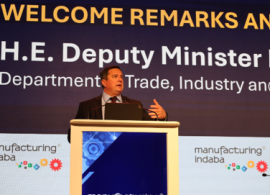
The manufacturing sector remains the backbone of every successful industrial economy, Trade, Industry and Competition (dtic) Deputy Minister John Steenhuisen said.
“Around the world, countries that have achieved sustained economic development have done so by building competitive manufacturing capabilities,” he said at the 2026 Manufacturing Indaba in Sandton, near Johannesburg on Tuesday.
He added that the manufacturing industry has the potential to create sustainable employment, drive technological innovation, raise productivity, stimulate exports, and create demand throughout the economy.
“In South Africa, manufacturing contributes approximately 13% of GDP [gross domestic product], accounts for more than 1.6 million direct jobs, and supports millions more indirect jobs across mining, agriculture, logistics, business services and the wider value chain,” he said.
Steenhuisen said every manufacturing job has a multiplier effect, creating additional opportunities in local supplier industries.
“The sector is therefore not simply another economic sector, it is the engine that transforms raw materials into higher-value products, strengthens domestic capabilities, and builds economic resilience. For this reason, governments across the world deliberately support manufacturing, as no country has industrialised by leaving it entirely to market forces.
“Support for the manufacturing sector can be costly but crucial for sustainable economic growth, and it can be viewed as an investment in productive capacity, decent jobs, technological capability, economic sovereignty, and long-term national prosperity.
“Such support, be it through industrial financing, infrastructure investment, localisation, public procurement, trade measures, skills development, or innovation incentives, should not be viewed merely as a cost but as a means of creating a conducive environment for the sector's growth,” he said.
He added that South Africa needs to recognise both the opportunities and challenges the industrial economy presents and then trim the sails of the country’s policies and approaches accordingly.
“The global economy is evolving due to rising geopolitical tensions, reconfiguration supply chains, climate change challenges, and the digitalisation of the economy, including the rise of AI which itself poses both disruption and opportunity.
“Governments focus to ensure South Africa's re-industrialisation is based on three core pillars: diversification, decarbonisation and digitalisation.
“Through diversification, the government aims to expand the economy beyond traditional resource extraction into high-value manufacturing, specifically targeting machinery, chemicals, automotive components, pharmaceuticals, and electro-technical goods,” he explained.
The Deputy Minister said the Special Economic Zones (SEZs) continue to provide globally competitive industrial platforms that attract investment, develop industrial clusters and improve export competitiveness.
“They have become important catalysts for industrial development by providing world-class infrastructure and enabling firms to integrate into regional and global value chains,” he said.
“We must foster important partnerships and collaboration opportunities between government, industry and organised labour.
|
“These collaborative programmes must support investment, localisation, economic inclusion and competitiveness across key sectors including automotive, steel, clothing and textiles, poultry, sugar, cannabis, furniture, medical devices, chemicals and other manufacturing industries,” he said. – SAnews.gov.za


