


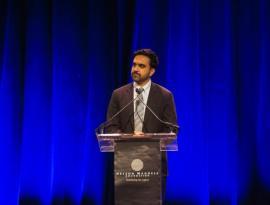
Nelson Mandela's legacy should be measured not by the praise he receives today - but by whether people are willing to show the same courage and solidarity in confronting today's injustices, New York City Mayor Zohran Mamdani said ahead of Mandela Day.
Delivering the keynote address at the inaugural Nelson Mandela Global Leadership Forum in New York on Wednesday, Mamdani challenged world leaders and citizens alike to honour Tata Madiba through action, rather than commemoration.
The forum, hosted by the Nelson Mandela Foundation at The Town Hall, was launched as a new platform for dialogue, democratic leadership and global engagement ahead of International Nelson Mandela Day on 18 July.
"For 27 years, this organisation has insisted that Madiba's legacy belongs not only in museums, but in movements for freedom too," Mamdani said, praising the Nelson Mandela Foundation's work.
Reflecting on Madiba's life and leadership, Mamdani said the former South African President's greatest legacy was his unwavering commitment to solidarity, even when doing so was politically unpopular.
"Madiba lives in every protest for justice, every call for democracy, every march with a righteous demand," he said.
Rather than treating the former statesman as a flawless historical figure, Mamdani urged people to remember his humanity.
Throughout his address, Mamdani drew on Mandela's 1990 town hall appearance in New York, shortly after his release from prison, describing how the anti-apartheid leader responded calmly to hostile questioning about his political alliances.
He argued that Mandela's refusal to compromise his principles demonstrated that solidarity should be universal rather than selective.
The Mayor used the speech to draw parallels between Mandela's struggle against apartheid - with contemporary global conflicts and political issues, including the war in Gaza, immigration, xenophobia and political imprisonment. He argued that history often vindicates those who are initially criticised for standing against injustice.
"Justice is not measured by where we stand after history has issued its verdict. It is measured by where we stand when the verdict is still being rendered," he said.
Mamdani also warned that economic inequality, political polarisation and social media algorithms were driving divisions within societies, making solidarity more difficult but also more necessary.
"The world we live in is designed to pull us apart," he said. "Solidarity is not perfection. Solidarity is people choosing one another, sometimes even over themselves."
As the world prepares to mark Mandela Day on 18 July, Mamdani said the annual commemoration should prompt people to ask whether they are supporting those facing injustices today. – SAnews.gov.za


