


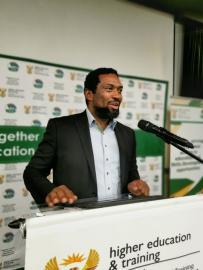
Higher Education and Training Minister Buti Manamela has called on African universities to fundamentally rethink inclusion, stressing that disability must be treated as a central design principle rather than an afterthought.
Speaking at the 3rd Edition of the Times Higher Education (THE) Africa Universities Summit in Nairobi, Kenya, Manamela said current participation rates for students with disabilities highlight the scale of exclusion across the sector.
In South Africa, students living with disabilities accounted for just 1.3% of public university enrolments in 2023, while across the broader post-school education and training system the figure stood at roughly 1%.
“These are not figures of inclusion at scale. They are signs of how much work remains to be done,” the Minister said.
Manamela argued that meaningful inclusion requires systemic change, extending beyond admissions to the way institutions are structured and operated.
He said the problem is not only at the point of admission, but also in infrastructure.
“The problem lies in infrastructure, digital design, assistive technology, curriculum adaptation, staff training, and whether institutions are built on the principle of universal accessibility or on the assumption of a 'normal' student. Inclusion is not a speech. It is design,” the Minister said.
Manamela highlighted that gender equality in higher education varies significantly across the continent.
While South Africa has achieved a female majority in enrolment, much of sub-Saharan Africa still faces barriers to women’s access to tertiary education, with roughly 80 women enrolled for every 100 men.
Using Kenya as an example, he noted that tertiary enrolment stands at about 13% for men and 10% for women, underscoring that parity remains a challenge in many countries.
Call for measurable justice and systemic reform
The Minister urged higher education leaders to shift from symbolic commitments to measurable outcomes, including publishing detailed, disaggregated data on enrolment, retention, completion, employment outcomes, disability access and leadership representation.
“Without that, we do not have transformation. We have anecdotes,” he said.
He also warned against simplistic narratives around gender, warning that progress for women should not obscure persistent inequalities, nor should concerns about declining male participation undermine efforts toward gender justice.
“The task is not to choose between women and men. The task is to build institutions capable of producing equality for all.”
Manamela also stressed that challenges within higher education reflect broader societal dynamics, including poverty, labour market inequality, social conditions and access to resources.
“The higher education question is inseparable from the social question,” he said, calling for coordinated reforms that include funding, curriculum transformation, safe and accessible campuses, and stronger links to the labour market.
Toward a more inclusive future
Manamela said South Africa’s experience demonstrates both the potential and the limitations of policy-driven change.
While progress has been made in expanding access, particularly for women, deeper inequalities persist in leadership, employment outcomes, and disability inclusion.
“Our task is to build an education system that reflects the society we want: balanced, fair, accessible and equal. Not access without success. Not inclusion without power. But real equality,” Manamela said. – SAnews.gov.za


