


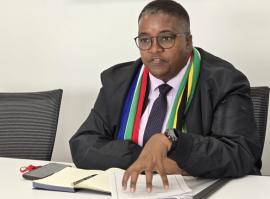
Deputy Minister in the Presidency for Women, Youth and Persons with Disabilities, Mmapaseka Steve Letsike, has warned that global Sustainable Development Goals (SDGs) cannot be achieved while systemic exclusion persists.
Speaking at the Pride Caucus Breakfast, held on the sidelines of the 2026 Ottawa Civic Space Summit, currently underway in Ottawa, Canada, Letsike called for inclusive development and the protection of human dignity, emphasising that inclusion must move from rhetoric to reality, if the world is to meet both SDGs and the African Union’s Agenda 2063.
“We cannot meaningfully speak about achieving the Sustainable Development Goals, or realising the aspirations of Agenda 2063, while entire groups of people remain excluded from the very systems that are meant to support them,” Letsike said.
The Deputy Minister is representing South Africa at the summit and contributing to the plenary on “Defend What Makes Democracy Possible: Civic Space in a Time of Rupture".
The summit, taking place from 21 – 23 April, brings together civil society organisations, governments, donors, media, academia, and private sector representatives to discuss strategies to defend civic freedoms, strengthen collaboration across sectors, and explore new tools and approaches to support inclusive democratic engagement.
The event also examines how civic space contributes to progress across areas, including human rights, gender equality, climate action, education, and humanitarian response.
Inclusion as a lived reality
Letsike anchored her remarks in a deeply personal narrative, recounting the experience of a young transgender individual in a South African township clinic who was denied care due to prejudice.
The story, she said, illustrates how exclusion often manifests quietly but with profound consequences.
“That is what shrinking civic space looks like in real life. It is not always loud or visible, but it carries an exclusionary message that is unmistakable: you do not belong here,” Letsike said.
Comparing this exclusion, Letsike highlighted Vilakazi Street, one of the most historically significant sites in South Africa, where the struggle against apartheid was lived and fought in real terms, as a site of transformation.
Once defined by exclusion and control, the street now hosts annual Soweto Pride, where Lesbian, Gay, Bisexual, Transgender, Queer, Intersex, and Asexual (LGBTQIA+) communities gather openly in affirmation of identity and belonging.
“As you stand in that space, you begin to understand that it is not simply a celebration. It is something much deeper, something more deliberate, because it is an act of reclaiming.
“When people march, gather, and take up space in that way, they are not asking to be included; they are asserting something that should never have been denied in the first place. They are saying, quite simply, we are here, we belong, and we are not leaving,” the Deputy Minister said.
Letsike warned that while visibility for marginalised groups is growing, civic space globally is under increasing pressure. Rights once considered secure are being reopened and debated, and identity is increasingly turned into a political battleground.
“This is not only about gender or sexuality, but also about something much broader that goes to the heart of democratic life. When a society begins to draw lines around who counts as fully human, who is worthy of dignity, who is entitled to protection, those lines do not remain contained. They expand and shift,” Letsike said.
She pointed to rising inequality, global conflict, and the climate crisis as compounding factors that disproportionately affect already vulnerable communities. These dynamics, she argued, reinforce exclusion and justify further restrictions on participation and dissent.
Highlighting cooperation between South Africa and Canada, Letsike acknowledged Canada’s role in supporting human rights and civil society initiatives. However, she stressed that civil society “cannot and should not carry” the burden of inclusion alone.
“Inclusion cannot be treated as an optional add-on to development—it is central to it,” she said.
She called for sustained investment in grassroots organisations, particularly those led by women, youth, and LGBTQIA+ communities, noting that many remain underfunded despite their critical role.
“Our investment must be flexible, responsive, and allow these organisations not only to survive, but to lead, innovate, and shape the futures we are all speaking about.”
Letsike also addressed narratives framing gender and LGBTQIA+ rights as “un-African”, or incompatible with culture and religion, arguing that such claims often ignore historical and cultural complexities shaped by colonial legacies.
“When we return to the core of African values—ubuntu, dignity, and community, we do not find exclusion, but connection, and a recognition that our humanity is bound up with one another,” she said. – SAnews.gov.za


