


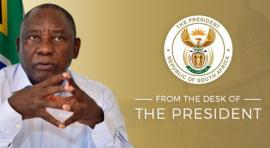
President Cyril Ramaphosa has, through his weekly newsletter, called on South Africans to celebrate the lives of struggle icons who fought and died for freedom.
The President’s call comes days after the reburial of struggle icon, Advocate Duma Nokwe, who the President recently conferred the honorary title of Senior Counsel (Silk).
In Monday’s newsletter, President Ramaphosa described the lives lost during the fight against Apartheid as a “heavy price” paid for the families that lost loved ones.
“For the many families and communities across this country who never got the opportunity to lay their loved ones to rest or to even know how they died, the past will continue to cast a long shadow. In the interests of national reconciliation; in the interests of moving forward, we will continue with our efforts to restore dignity to all those who were denied it in life.
“A heavy price was paid by many for the democracy we have today. This should continue to inspire us as we work together towards a shared future,” he said.
Following the fall of the apartheid government, South Africa established the Truth and Reconciliation Commission (TRC) described by President Ramaphosa as an attempt to “shed a light on the atrocities committed during apartheid”.
“Even as democratic South Africa attempted to unearth what happened and to hold those accountable to account, many apartheid-era security officials either refused to appear before the TRC or did not fully disclose their actions. Others resorted to delaying tactics and obstruction to evade trial.
“As we recently announced, I am in the process of establishing a judicial commission of inquiry to look into allegations of interference in the investigation and prosecution of apartheid-era crimes referred by TRC,” he said.
Repatriating heroes
During the apartheid era, several political parties faced banning orders from the racist government – forcing many activists into exile.
Some activists – like Advocate Duma Nokwe – died while in exile with their remains still in those countries.
READ | Adv Duma Nokwe honoured for fighting against apartheid
President Ramaphosa assured families still waiting for the return of the remains of their loved ones that government is “steadfast in our commitment to restoring the dignity of activists who died and were buried abroad, and to our country men and women who were subjected to indignities in foreign lands.”
“This is being done within legal frameworks such as the National Heritage Resources Act. This framework facilitated the repatriation of Sara Baartman’s remains for burial in South Africa in 2002. We have also developed a draft National Policy on the Repatriation and Restitution of Human Remains and Heritage Objects which will guide our efforts going forward.
“The Department of Sport, Arts and Culture and other government institutions continue to engage with several countries to facilitate the return of human remains,” he said.
The President reflected that although dealing with “the memory of past atrocities is one of the most difficult and delicate tasks a nation can undertake,” it can be a “cathartic process”.
“[It] is vital if a country is committed to enhance national healing, cohesion and unity. The way a country remembers its painful past can shape the character of its democracy, the legitimacy of its institutions and the resilience of its people.
“As a country, we have had to contend with our past in the interests of social cohesion and nation-building. We have advanced policies of restitution and redress to both acknowledge and correct the historical injustice of apartheid.
“We remain equally committed to restoring the dignity of apartheid’s countless victims and to bringing closure to their families,” President Ramaphosa said. – SAnews.gov.za


