


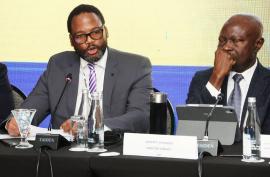
Employment and Labour Deputy Minister Jomo Sibiya has called for the dismantling of the misconception that competitiveness and fairness cannot co-exist in the global labour market.
The Deputy Minister was delivering remarks at the Labour 20 (L20) South Africa 2025 Summit.
“Let us be clear: fair wages, decent work and strong social protection are not barriers to growth, but they are the foundations of resilient , future ready economies. The anticipated Employment Working Group declaration lays groundwork for these efforts.
“It recognises that full and productive employment, adequacy and sustainability of social protection systems, wage settings mechanisms, grounded in rights and fairness, are essential to build a just and inclusive societies. It calls on all of us to expand formalisation and reverse decoupling of wages from productivity,” Sibiya said on Tuesday.
The summit was held under the theme: ‘Fostering solidarity, equality and sustainability through a new social compact''.
The L20 represents workers' interests at the G20 level, bringing together trade union representatives from G20 countries and international trade union federations. It is coordinated by the International Trade Union Confederation (ITUC) and the Trade Union Advisory Committee (TUAC) of the Organisation for Economic Cooperation and Development (OECD).
The G20 labour component has also been active since the global financial crisis in 2008.
Through its existence, L20 aims to ensure that the voices of workers are heard in discussions on issues of economic policies and labour rights. South Africa's labour federations – Congress of South African Trade Unions (Cosatu), Federation of Unions of South Africa (Fedusa), National Council of Trade Unions (Nactu) and the South African Federation of Trade Unions Saftu – attended the summit.
Sibiya commended the L20’s commitment to tackling major labour market challenges, including inequality, declining real wages, and the shrinking labour income share of gross domestic product (GDP).
“The issues strike at the very heart of our societies and also manifest in growing hardship for working families, the erosion of social cohesion as well as pervasive sense among workers that growth is no longer working for them.
“For the global south, the value of labour has been steadily diminishing. Productivity had risen but workers, particularly those at the lower end of the wage distribution, have not benefitted. The disconnect between the creation of wealth and its distribution is not only unjust, but also unsustainable.”
Priorities
Sibiya said South Africa's employment track has been anchored in four key priorities:
• Promoting inclusive growth and youth employment to ensure that every young person has access to a decent job.
• Accelerating gender equality in the workforce by addressing systemic barriers to women's full and equal participation.
• Reversing the decline in labour income share, so that workers regain the dignified and fair share of the value they help to generate.
• Harnessing digitalisation to create an inclusive future of work rather than deepening the digital divide.
“Genuine economic growth is closely tied to decent work. This calls for us to actively shape policies and institutions to achieve fair labour market results, necessitates establishing wage systems whether through legislation or collective bargaining that assure a living wage, alongside investment and social protection for life-long income, security and strengthen social dialogue to empower both workers and employers,” he said.
The importance of financial literacy among workers was also emphasised with the Deputy Minister saying there is a need to “capacitate workers of the world on how to take responsibility of their livelihood, making sure that they use their hard-earned salaries properly.”
He added that South Africa’s own experiences offered valuable lessons in addressing inequality and unemployment.
According to Sibiya, social partners continue to play a vital role in shaping labour market reforms – this amidst structural constraints.
“We strongly believe that when working together as government with social partners that is where solutions can be found. Our work is far from over. We must recommend social justice in our economic strategies,” he said.
The L20 component engagements were also held alongside the 4th G20 Employment Working Group meeting held at Fancourt in George earlier this week.
The aim of the L20 session was to have a dialogue between trade unions and certain G20 labour and employment Ministers to discuss joint approaches to tackling inequality, fostering wage increases, and increasing the labour income share, as a key priority of this year's employment track. – SAnews.gov.za


