


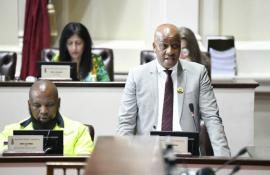
KwaZulu-Natal Premier Thamsanqa Ntuli has reaffirmed the province’s commitment to accountability, cooperative governance, and community-centred service delivery.
This comes as the National Council of Provinces (NCOP) convened its “Taking Parliament to the People” programme at the KwaZulu-Natal Legislature in Pietermaritzburg.
The programme, one of South Africa’s most significant participatory democracy platforms, brings national lawmakers into direct engagement with communities to listen, observe, and respond to service-delivery challenges raised by citizens.
The KwaZulu-Natal delegation of permanent delegates to the NCOP crisscrossed the uMgungudlovu municipal area from 19 to 20 November 2025, to assess the progress of various infrastructure development projects.
Premier Ntuli described the engagement as a constitutional imperative that ensures Parliament remains close to the people it serves, especially those whose voices often go unheard.
He said the NCOP’s focus on the uMgungundlovu District provide the province an opportunity to reassess progress and confront persistent service-delivery obstacles, and [refine government’s developmental approach.]
Economic and large-scale investment
The Premier highlighted notable progress across the province, including economic renewal and large-scale investment.
At the 2025 KZN Investment Conference, the province secured R100.1 billion in commitments across 34 major projects, which are expected to create both direct and indirect employment opportunities.
“Infrastructure development continues to accelerate, with catalytic corridors in eThekwini, tourism developments in iLembe, and major water schemes such as the R463 million Greater Mthonjaneni Bulk Water Project,” the Premier said.
He also highlighted the establishment of the KwaZulu-Natal Infrastructure Council, which oversees a R3.9 trillion long-term project pipeline focused on inclusive growth; climate resilience; integrity in procurement and broader participation of rural communities; small, medium and micro enterprises (SMMEs), women and youth.
Road rehabilitation remains a major priority, with more than 5 million square metres of roads currently being resurfaced or repaired.
Ntuli said the province has strengthened partnerships with the South African Police Service (SAPS) to address construction mafia disruptions, enabling critical infrastructure projects to proceed safely.
“Through SAPS partnerships, disruptions caused by construction mafias are being contained, allowing projects to proceed safely,” the Premier said.
Ntuli added that KwaZulu-Natal is intensifying its climate-resilience planning.
“The Climate Change Council continues to prioritise climate-resilient infrastructure, early-warning systems, responsible land-use planning, and the growth of green industries aimed at youth employment.”
Despite progress, Ntuli acknowledged persistent water supply challenges, especially in Ugu, Zululand, uThukela and uMzinyathi, while urban centres such as Msunduzi, KwaDukuza and Newcastle face sewage failures and ageing sanitation networks.
He said illegal dumping, which the NCOP highlighted sharply during its walkabouts in uMgungundlovu, remains an urgent environmental and health concern across multiple municipalities.
“Electricity availability sits at more than 93 percent in the province, yet local networks are increasingly strained by illegal connections, vandalism, and ageing infrastructure. Municipal financial recovery is non-negotiable, especially as some government departments continue to carry substantial debt to municipalities, undermining local capacity,” the Premier said.
To stabilise governance, the Premier outlined several interventions, including strengthened intergovernmental forums, improved coordination through the District Development Model, and Section 154 support for financially distressed municipalities.
He cited improvements in Msunduzi Municipality as evidence that targeted oversight and expert deployment can restore administrative and financial stability.
Community safety also featured prominently in Ntuli’s address. He argued that economic development and service delivery cannot thrive without safe communities, as insecurity disrupts clinics, schools, and municipal operations.
“The province is expanding intelligence-driven operations, enhancing rural safety, deploying specialised law-enforcement support to high-risk municipalities, installing CCTV systems, and strengthening school-safety and youth-at-risk programmes,” he said.
Ntuli stressed that building capable municipalities is crucial to long-term progress, warning that without strong financial controls, engineering capacity and effective governance systems, infrastructure plans collapse before implementation.
“Building capable, reliable municipalities is a moral responsibility owed to every household in KwaZulu-Natal.”
The Premier also urged the NCOP to support the province in reviewing equitable-share allocations, fast-tracking disaster relief funding, enforcing municipal turnaround plans, and addressing national logistics constraints affecting development, including port inefficiencies, rail limitations, and special economic zone blockages. - SAnews.gov.za


