


Infrastructure investment remains a key component in driving economic growth and government has maintained its R1 trillion allocation for infrastructure investment over the medium term to support this growth.
This according to Finance Minister Enoch Godongwana, who delivered the Budget Speech in Parliament on Wednesday.
“[Quality] infrastructure investment expands the productive capacity of the economy and responds to the diverse needs of the citizens. Infrastructure is also a rich source of jobs in construction, engineering, and related industries across a range of skill levels.
“It is for these reasons that infrastructure is the fourth pillar of the growth strategy, and this budget demonstrates our resolve to change the composition of spending from consumption to investment. Allocations towards capital payments remain the fastest-growing area of spending by economic classification. Public infrastructure spending over three years will exceed the R1 trillion mark,” Godongwana said.
Spending will focus on “maintaining and repairing existing infrastructure, building new infrastructure, and acquiring equipment and machinery” primarily in transport and logistics, energy and water and sanitation.
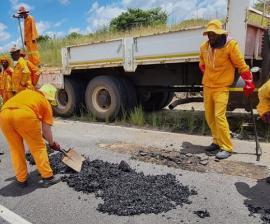
“Of the R402 billion for transport and logistics, R93.1 billion is for the South African National Roads Agency to keep the 24 000-kilometer national road network in active maintenance and rehabilitation. R53.1 billion is for the maintenance and refurbishment of provincial roads.
“R66.3 billion is allocated to PRASA, out of which R18.2 billion is for the rolling stock fleet renewal programme and R12.3 billion is provisionally allocated for the renewal of the signalling system. The spending will sustain progress in rebuilding the infrastructure to provide affordable commuter rail services. This will enable PRASA to increase passenger trips from 60 million in 2024/25 to 186 million by the end of the MTEF [Medium Term Expenditure Framework] period.
“The energy sector will invest R219.2 billion on strengthening the electricity supply network, from generation to transmission and distribution. The water and sanitation sector will spend R156.3 billion on expanding our water resource and service infrastructure, including dams, bulk infrastructure to service mines, factories and farms,” Godongwana explained.
Reforms for private sector participation
The Minister announced that new regulations for public-private partnerships (PPPs), which were gazetted earlier this year, are expected to take effect next month.
“These will reduce the procedural complexity of undertaking PPPs, increasing the deal flow and allowing government to leverage its limited resources to fast-track infrastructure provision. The National Treasury has developed enabling guidelines and frameworks to support the new regulations.
“Specifically, the unsolicited proposals framework will create clear rules for managing proposals from the private sector. And the framework for fiscal commitments and contingent liabilities will strengthen fiscal risk governance. These guidelines and frameworks will be published in the next few weeks,” he said.
Furthermore, the process of issuing the first infrastructure bonds in 2025/26 remains in place.
“We are also exploring alternative financing instruments to allow pension funds, commercial banks, development banks and international financial institutions to participate in financing our infrastructure plans.
“These reforms are how we plan to leverage infrastructure investment to ease supply side constraints to the economy and improve access to social services the people get,” Godongwana said.
Employment boost
Meanwhile, in the 2025 Budget Overview, National Treasury said additional funding of some R8.8 billion has been allocated to public employment programmes (PEPs).
“Although the number of people employed was 16.8 million in the first quarter of 2025, South Africa’s unemployment rate remained very high at 32.9%.
“Public employment programmes are crucial to address persistently high unemployment,” National Treasury noted.
Key beneficiaries for the additional funding include:
- The Department of Basic Education: R5.8 billion for the basic education schools employment initiative.
- The Department of Sport, Arts and Culture: R350 000 000 for the creative industry stimulus.
- The Department of Trade, Industry and Competition: R1.3 billion for the Social Employment Fund.
“In addition, National Treasury and the Presidency, working with other state institutions, have begun a comprehensive review of active labour market programmes, PEPs and the social support system to improve efficiency and effectiveness.
“With these efforts, government hopes to make significant strides in reducing unemployment,” the overview read. – SAnews.gov.za


