


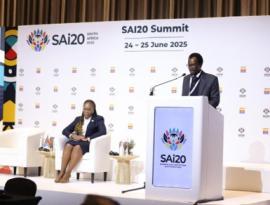
The Deputy Minister of Finance, Dr David Masondo, has reiterated that infrastructure development plays a significant role in government’s ongoing efforts to grow the economy, create jobs and deliver services to citizens.
“As the South African government, we have committed significant investments towards infrastructure development. We have ambitious infrastructure development programs that have been undertaken in our country,” Masondo said on Tuesday, at the Supreme Audit Institutions (SAI20) Summit.
The SAI20 is an engagement group of Supreme Audit Institutions (SAIs) from countries that make up the Group of Twenty (G20). It is chaired by the SAI of the country holding the G20 presidency.
South Africa assumed the G20 Presidency on 1 December 2024 and it will run until November 2025 under the theme: Solidarity, Equality, and Sustainability.
The Deputy Minister said the country’s ambitious infrastructure development is necessitated by government’s desire to grow the economy through increasing the role of the private sector in the supply of electricity, freight logistics, telecommunications and water.
“We are working with other international partners towards revitalising ports and harbours. We are upgrading our electricity and digital infrastructure. We are building roads, hospitals and schools. We do all these to improve the socio-economic conditions of ordinary South Africans,” Masondo said.
In March 2025, Minister of Transport Barbara Creecy launched an online Request for Information to develop an enabling environment for private sector participation and enhanced investment in rail and port infrastructure and operations.
Last month Transnet issued a R17 billion concession contract to five private sector partners to fund, construct and operate several liquid bulk terminals at the Port of Richards Bay.
Government has been collaborating with stakeholders to address bottlenecks and inefficiencies to turn around the fortunes of the rail and ports logistics systems.
Through Operation Vulindlela, government is accelerating the implementation of structural reforms to enable economic growth and job creation.
Operation Vulindlela is a joint initiative between the Presidency and National Treasury.
In its first phase, the reform programme focused on five area, namely energy, logistics, water, telecommunications, and the visa system, which were identified as the most important constraints on economic growth.
Government has made significant progress in advancing the reform agenda during implementation of Phase I of Operation Vulindlela as almost all of the reforms included in Phase I are either completed or on track.
The initiative is now in its second phase and the focus areas include improving the performance of local government, addressing spatial inequality through housing policy and other reforms, and advancing digital transformation.
It will include a rapid rollout of digital public infrastructure, such as digital identity and payments to enable economic activity and improve access to government services. -SAnews.gov.za


