


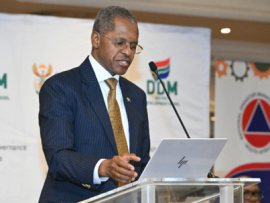
Cooperative Governance and Traditional Affairs Minister Velenkosini Hlabisa emphasised on Tuesday that adopting prevention-oriented, proactive strategies is essential for disaster management.
“By prioritising risk assessment, mitigation efforts, and community preparedness, we can significantly reduce the potential impact of disasters before they strike,” the Minister said.
Addressing the National Disaster Management Strategic Indaba at Emperors Palace in Boksburg, Johannesburg, Hlabisa said the growing intensity and frequency of disasters in recent years underscore the urgent need to move beyond traditional reactive disaster management strategies.
According to the Minister, this historical approach, which focuses primarily on responding to disasters after they occur, “has proven insufficient in the face of escalating natural and man-made threats.”
Held under the theme: “Strengthening Disaster Management Functions across the country”, the Indaba brought together representatives from government, practitioners, academia, civil society and the private sector to strengthen a prevention-focused approach to disaster management.
Hlabisa described the gathering as a critical opportunity to reshape South Africa’s disaster management system into one that is proactive, integrated, and effective.
“Our task today is very clear. We need to move decisively from fragmented, reactive responses toward a coherent, prevention-focused, and risk-informed disaster management system.
“Our country faces significant and intensifying disaster risks, including floods, droughts, wildfires, severe storms, and tornadoes. These risks are driven by climate change, rapid urbanisation, environmental degradation, and socio-economic inequality,” the Minister said.
Hlabisa cited recent disasters as evidence of the country’s vulnerability.
These include the April 2022 floods in KwaZulu-Natal, which displaced more than 40 000 people and claimed over 500 lives, exposing weaknesses in infrastructure resilience and emergency preparedness. In June 2025, severe flooding in the Eastern Cape resulted in over 200 fatalities, further highlighting the need for improved systems.
More recently, floods in Limpopo and Mpumalanga in early 2026 led to loss of life, displacement of families, and extensive damage to critical infrastructure.
“Communities were caught off guard, highlighting the urgent necessity for improved early warning systems and rapid response mechanisms,” the Minister said.
Beyond flooding, persistent threats from severe droughts, wildfires, and storms continue to disrupt agricultural production, local economies and livelihoods across provinces. Vulnerable groups, including women, children, older persons, people with disabilities and marginalised communities, continue to bear the greatest burden, largely due to pre-existing inequalities and limited access to resources and services.
Hlabisa noted that while South Africa has a solid legislative framework, including the Disaster Management Act of 2002 and the National Disaster Management Framework, “legislation alone cannot guarantee success.”
“The effectiveness of these frameworks hinges on strong leadership, effective coordination, diligent enforcement, and comprehensive implementation,” he said.
Proactive strategies
The Minister emphasised that a fundamental transition to prevention-oriented strategies must become the cornerstone of disaster management.
By prioritising risk assessment, mitigation efforts, and community preparedness, the country can significantly reduce the potential impact of disasters before they strike.
“The familiar phrase 'prevention is better than cure,' transcends mere cliché; it represents a vital strategic imperative. Investing in preventive measures not only saves lives but also preserves livelihoods and strengthens community resilience in the long term.”
Risk-informed planning, prevention and mitigation, improved preparedness and early warning systems,and sustainable recovery strategies were among the key priorities highlighted.
The Minister said municipalities play a vital role as the first line of defence against disasters and are essential for tackling the root causes of these disasters, which are often complex and multifaceted. However, they face significant challenges, including poor spatial planning, inadequate infrastructure maintenance, and the expansion of settlements in high-risk areas.
He called for fully functional and well-resourced Disaster Management Centres in all municipalities, supported by funded and regularly updated disaster management plans.
“Empowering communities is essential for effective disaster risk reduction. Local residents must be engaged as active partners in the planning and implementation of these strategies. True success in disaster management is achievable only when the community is involved, motivated, and prepared to act alongside municipalities,” Hlabisa said.
He also underscored the importance of effective early warning systems that are technologically advanced and methodologies that can accurately detect and predict potential threats.
“The system should be able to disseminate timely alerts and information through multiple channels, such as mobile notifications, community meetings, and local radio, so that everyone receives the necessary information well in advance.”
Incorporating advanced technology
Hlabisa also underscored the importance of resilient infrastructure, including roads, bridges and housing, saying they must be meticulously designed, constructed, and maintained to endure the impacts of natural hazards.
“This means not only selecting appropriate materials and innovative engineering practices but also incorporating advanced technology to predict and respond to potential threats.
“Equally significant is the need for ongoing maintenance of such infrastructure. Without regular assessments and maintenance, even the most robust structures can deteriorate, leaving them vulnerable during critical moments when their performance is needed most,” he said. -SAnews.gov.za


