


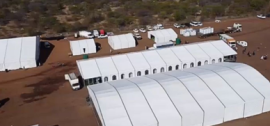
The recently announced Temporary Repatriation Processing Centre (TRPC) in Musina has commenced operations aimed at enabling the faster processing and verification of undocumented foreign nationals as well as facilitating efficient clearance through the Beitbridge port of entry in Limpopo.
Operations are also aimed at reducing reliance on the Lindela Repatriation Centre in Gauteng and improving overall system throughput.
Addressing the media on Sunday, Inter-Ministerial Committee (IMC) Chairperson and Justice Minister Mmamoloko Kubayi said the TRPC can accommodate some 20 000 people and is serviced by various stakeholders including embassies, the Department of Home Affairs (DHA), law enforcement agencies and local government.
“More than 20 000 foreign nationals [Malawians, Zimbabweans and Mozambicans] have been repatriated through the TRPC.
“The repatriation centres utilised in eThekwini and Umsunduzi officially closed on 30 June 2026 and all Malawian nationals who had assembled prior to 30 June were transferred to the TRPC; these include those that were at the Musina Refugee Reception Centre and Musina Showgrounds who were transferred by 03 July 2026
“Repatriation processes are undertaken at the TRPC; however, the process starts at a point where foreign nationals assemble prior to transportation to the TRPC,” Kubayi explained.
Transportation is serviced through the DHA together with municipalities, various embassies, law enforcement and other non-governmental organisations (NGOs).
Kubayi noted that “scores of people continue to arrive across various centres to take advantage of the repatriation process”.
These arrivals, she added, are causing strain on local resources and “pose significant risks of health hazards and outbreaks”.
“In this regard, we have put emergency measures to respond to these spontaneous arrivals and have asked our local authorities to ensure an orderly management of this situation.
“We will be deploying more resources in this regard, including accelerated transport arrangements to ensure that we clear the pavements and public spaces that are continuously occupied by these arrivals.
“We call on foreign missions and relevant authorities in the fraternity of repatriating countries to continue working with us in this regard and to plead with their respective nationals to follow established protocol in the repatriation process,” Kubayi urged.
Repatriation operations
The repatriation of foreign nationals has declined from 4805 on 5 July to some 1139 people on 11 July 2026.
“As such, we are in discussion with relevant authorities and stakeholders about the process of scaling down our efforts and deployment of resources for this process.
“We envisage a phased scaling down of the process which will not negatively impact or compromise both the deportation and repatriation processes we are undertaking,” Kubayi said.
She explained that the temporary measures taken to speed up repatriation are “costly to our fiscus [and] were never meant to be permanent”.
“The State however, remains with the legal obligation to continuously deport those who are found to have transgressed the Immigration Act.
“As such, a total of 15 398 foreign nationals have been deported between 1 April 2026 and 30 June 2026. During the same period, 2519 joint law enforcement operations were undertaken,” Kubayi said.
Arm of the law
Meanwhile, immigration dedicated courts in KwaZulu-Natal continue their work with 2640 immigration cases finalised for deportation.
“The re-establishment of a court at Lindela [Repatriation Centre in Gauteng] will ensure that deportations from Lindela Repatriation Centre will be expedited.”
She added that the work to provide designated offices for the court is at an advanced stage and will be completed within a month.
“Similarly, work to establish a court that handles, among others, immigration cases is advanced, and the Airports Company of South Africa (ACSA) has provided space. The process of setting up the court is envisaged to take three months,” Kubayi said. – SAnews.gov.za


