


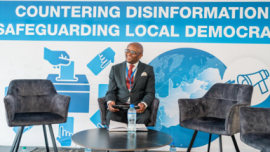
As South Africa prepares for the 2026 Local Government Elections, the rise of generative artificial intelligence (AI) and its use in hyper-local disinformation campaigns has emerged as a key concern for the Electoral Commission of South Africa (IEC).
IEC Chairperson Mosotho Moepya warned that the 2026 polls are likely to see a shift from broad national misinformation to ward-specific deceptions driven by generative AI tools.
“The primary challenge of 2026 is the rise of Generative AI and its application in ‘hyper-local’ contexts. We are seeing a shift from broad national untruths to ward-specific deceptions. As identified by the South African National Editors’ Forum (SANEF), we expect a ‘flurry of deepfakes’ in these municipal elections,” Moepya said.
He was speaking at the Disinformation Dialogue 2026: “Countering Disinformation, Safeguarding Local Democracy” held in Cape Town on Wednesday.
The dialogue was hosted by the Institute of Security Studies, in collaboration with the delegation of the European Union, Embassy of Spain, Poland, Bulgaria, Lithuania, and Flanders State of the Art. This strategic dialogue on disinformation holds relevance in the digital age, across international borders, as well as locally as South Africa prepares for Local Government Elections this year.
Moepya said procedures most vulnerable to manipulation include the voters’ roll, the transportation of ballot boxes and the manual tallying of votes at stations.
“Disinformation targets these points because they involve human elements that can be misrepresented,” he said.
In response, the IEC is implementing a 2026 strategy that includes direct-to-citizen verification tools, enabling voters to confirm ward boundaries and registration status through zero-rated digital portals.
The Commission is also establishing “Rapid-Response Pathways”, linking local community radio stations and youth networks directly to fact-checking hubs aimed at countering false information at community level.
Other measures form part of what Moepya described as a shift from a “defensive” posture to one of “radical transparency”.
These include the “News Sausage” approach, which encourages media houses to show the public how election results are audited and verified in order to reduce suspicion and conspiracy theories, as referenced by the South African News Editors’ Forum (SANEF).
The IEC will also rely on legal mechanisms, including the Cybercrimes Act and the Electoral Code of Conduct, to ensure that individuals who intentionally spread harmful digital disinformation face legal consequences.
Moepya said technology remains a “double-edged sword”.
“It can be the tool that disenfranchises a grandmother in a rural village through a viral lie, or it can be the tool that empowers a first-time voter in a bustling township to verify their ballot.
“The integrity of our 2026 Local Government Elections does not rest on the IEC alone. It rests on the fact-checker in Johannesburg, the lawmaker in Cape Town, the tech engineer in Silicon Valley, and the EU [European Union] diplomat in Pretoria,” he said.
The dialogue brought together high-level political representatives, lawmakers, international experts, the IEC, government departments, local government representatives and media organisations.
Moepya said the Commission has subjected its Voter Management Devices (VMDs) and results systems to independent end-to-end testing to ensure the technology used at the 23 292 voting stations are transparent and verifiable.
“We have subjected our VMDs and results systems to independent, end-to-end testing, ensuring that the technology used at the voting stations is not a ‘black box,’ but a glass one,” he said. – SAnews.gov.za


