


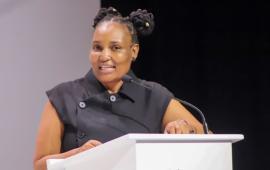
Human Settlements Minister Thembi Simelane says the future of human settlements delivery depends on the ability to align planning, infrastructure, financing, regulation, and implementation behind a common vision.
The Minister's remarks come as the Department of Human Settlements faces significant budget constraints, with R26.97 billion allocated for the 2026/27 financial year, representing a reduction of nearly R7 billion compared with the previous year.
Addressing the Tshwane Human Settlements Symposium in Centurion on Tuesday, Simelane said mounting housing demand, rapid urbanisation, infrastructure constraints and budget pressures require government and its partners to adopt more innovative and coordinated approaches to housing delivery.
She warned that the budget cuts would have a substantial impact on the department's Medium-Term Development Plan targets, making partnerships and innovation increasingly critical to achieving housing objectives.
"This means, going forward, we will have to do more with less and become more innovative in how we deliver human settlements. These realities require us to think differently, stronger partnerships, innovation, and most importantly, they require coordinated action,” Simelane said.
Despite financial pressures, the Minister said the department has set ambitious national targets for the current financial year, including the delivery of 39 058 housing units, completion of 25 186 serviced sites, approval of 11 358 First Home Finance applications, and the disbursement of 9 231 housing subsidies.
She stressed that housing development opportunities must be understood beyond the traditional delivery of top structures, and include fully subsidised housing, serviced sites, affordable home ownership opportunities, rental and social housing, first home finance, mixed-use developments, and the release of well-located land for integrated human settlements.
The Minister highlighted that the First Home Finance Programme has exceeded its target by 200% during the 2025/26 financial year, assisting 8 544 households compared with an initial target of 4 272.
She said the programme's performance demonstrates the effectiveness of partnerships between government, financial institutions, and developers in expanding access to affordable housing.
"The gap market is real. Demand is strong. Government support can unlock home ownership when it is properly aligned with financing institutions, developers, and beneficiaries," the Minister said.
Infrastructure remains a major constraint
Simelane identified inadequate infrastructure and delays in land release as some of the biggest obstacles to housing delivery.
She noted that South Africa faces an estimated infrastructure financing shortfall of approximately R13 trillion, warning that housing projects cannot succeed without sufficient bulk infrastructure.
"A housing project without bulk infrastructure is a promise waiting to fail. A land parcel without water, sanitation, roads, and electricity is not yet a settlement opportunity. A well-located land parcel that is not released, serviced, or connected to infrastructure remains potential rather than delivery,” the Minister said.
She said the department has prioritised efforts to unblock stalled housing projects. During the 2025/26 financial year, 85 of 212 blocked projects identified nationwide were successfully unblocked, resulting in the delivery of 1 136 housing units across several provinces.
“This experience has taught us that projects are rarely blocked by a single issue. The issues are multi-layered and multi-context.”
The Minister also outlined several regulatory reforms aimed at accelerating housing delivery and creating greater certainty for investors.
These include the development of a new Human Settlements Act to replace the Housing Act of 1997, a modernised Human Settlements Code and amendments to the Prevention of Illegal Eviction and Unlawful Occupation of Land Act.
The reforms intend to improve policy coherence, reduce administrative bottlenecks and unlock development-ready land.
"There is no developer, investor and financier who would want to invest in a chaotic environment," Simelane said, referring to proposed amendments to legislation governing unlawful occupation of land.
Blended finance and innovation
Simelane called for greater use of blended finance models, arguing that public funding alone cannot meet the country's housing needs.
She said government resources should increasingly be used to attract investment from commercial banks, development finance institutions, pension funds and the private sector.
"Investment follows certainty. Where projects are well planned and development-ready, financing becomes easier to mobilise and implementation becomes easier to achieve," Simelane said.
Concluding her address, Simelane emphasised that the success of the country's human settlements programme would ultimately depend on stronger collaboration among government, municipalities, developers, financiers, researchers and communities.
"The true measure of this symposium will not be today's discussions. It will be the actions that follow. Together, we can build sustainable, inclusive, and resilient human settlements that improve lives, restore dignity, and contribute to South Africa's long-term development," Simelane said. – SAnews.gov.za


