


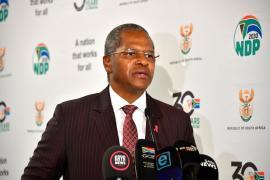
Minister of Cooperative Governance and Traditional Affairs, Velenkosini Hlabisa, has urged religious leaders to promote peace and stability and to assist in creating safe spaces for women and children, free from fear and violence.
The call comes as the country continues to confront the issue of gender-based violence (GBV).
“Together, as leaders in diversity, we have a collective responsibility to build a society rooted in constitutional values, where every human being enjoys dignity, equality, and freedom,” he said on Monday.
Hlabisa spoke at the second Faith-Governance Conference hosted by the South African Community of Faith-based Fraternals and Federations (SACOFF) in partnership with the Institute for Global Engagement (IGE) on Monday at the Irene Country Lodge in Pretoria.
He informed the delegates that femicide rates in South Africa are five times higher than the global average, and that one in three women has experienced physical violence in her lifetime.
“These numbers are not statistics; they represent shattered families and broken communities. This is why President Cyril Ramaphosa recently classified gender-based violence and femicide (GBVF) as a national disaster, calling for urgent and coordinated action.”
On Thursday, 20 November 2025, President Ramaphosa declared GBVF a national crisis during the closing ceremony of the Group of 20 (G20) Social Summit at the Birchwood Hotel and OR Tambo Conference Centre in Ekurhuleni.
He also called on leaders to promote tolerance and respect for diversity in race, gender, religion, culture, and language while mobilising communities to eradicate crime, corruption, and GBV.
“Faith-based organisations are already making a difference. SACOFF, for example, represents over 20 900 faith-based organisations nationwide that work on food security, early childhood development, GBV prevention, and disaster relief. These partnerships demonstrate the power of faith communities to deliver social impact at scale.”
Hlabisa described Monday's gathering as more than a meeting; it is a reaffirmation of our shared responsibility to shape a society that embodies the highest ideals of justice, peace, and human dignity.
The interfaith initiative aims to strengthen the relationship between faith and state to build a united South Africa and a better Africa for all.
“We are here because we recognise that faith communities are not passive observers; they are active partners in transforming society.”
Hlabisa also praised religious formations for historically playing a critical role in the struggle against colonialism, apartheid, and poverty.
“Today, they remain central to efforts to eradicate unemployment, inequality, and social injustice. Churches, mosques, synagogues, and temples must continue to serve as pillars of society, providing education, feeding the poor, and speaking out against corruption, GBV, and substance abuse.” – SAnews.gov.za


