


African leaders have underscored the urgent need for coordinated action to tackle the immediate burden of high debt service costs and address the underlying causes of recurring debt crises on the continent.
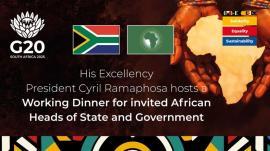
These sentiments were expressed by African Heads of State and Government, the African Union (AU), and African organisations, on the margins of the 2025 Group Twenty (G20) Leaders’ Summit, during a working dinner that was convened by President Cyril Ramaphosa on Friday in Johannesburg.
They expressed strong support for the G20 Ministerial Declaration on Debt Sustainability, which signals the intent of the G20 to do more to tackle unsustainable levels of debt alongside the rising cost of capital, particularly for African countries.
Africa faces growing financing pressures as rising debt service costs severely constrain development.
By end-2024, public debt had reached USD 1.815 trillion, while annual debt servicing climbed to USD 163 billion, leaving 57% of Africans living in countries where debt payments exceed health or education spending.
The high level of debt is unsustainable and undermines efforts towards sustainable development and poverty alleviation.
“African leaders supported the creation of a global Borrowers Platform to strengthen technical cooperation and amplify borrower voices, with a United Nations entity as its secretariat.
“The establishment of the platform will improve the governance and operation of the global debt architecture. African leaders committed to working together in a spirit of cooperation to establish the Borrowers’ Platform over the next year and welcomed South Africa’s offer to convene the inaugural meeting of the platform in 2026,” the Presidency said.
President Ramaphosa highlighted the rising debt burden on African countries as an issue that requires action by the international community.
The Africa Expert Panel, chaired by former Minister of Finance Trevor Manuel, presented its report to African leaders, who welcomed its proposals.
The report puts forward simple, straightforward actions to accelerate investment in Africa, including disclosing project-level financial data to reduce investment costs and making simple adjustments to global banking regulations to unlock more finance for infrastructure and development.
Further actions include ensuring that the methods of credit rating agencies are sound, their sources fully disclosed, and their actions subject to regulatory oversight; and strengthening debt transparency and ensuring that creditors participate in reconciling debt data.
“President Ramaphosa committed to take the proposals of the panel forward not only in the G20 but in other international fora, working closely with the African Union and other partners.
“African leaders further welcomed the Report of the G20 Extraordinary Committee on Global Inequality which was commissioned under South Africa’s G20 Presidency and supported the Committee’s proposal to create a permanent International Panel on Inequality which will provide policymakers, the private sector, and the public with authoritative assessments on inequality, and ensure that inequality continues to be discussed by leaders as in the G20 and other multilateral fora,” the Presidency said.
The meeting discussed the four high-level priorities that anchored the work of South Africa’s G20 Presidency, namely:
- Strengthening disaster resilience and response;
- Ensuring debt sustainability for low-income countries;
- Mobilising finance for a just energy transition; and
- Harnessing critical minerals for inclusive growth and sustainable development.
Heads of State and Government from the world's largest economies will gather on Saturday and Sunday in Johannesburg at the G20 Leaders’ Summit to discuss and coordinate on major global issues.
G20 members include the world’s major economies, representing 85% of global GDP, 75% of international trade, and two-thirds of the world’s population.
The G20 comprises 19 countries (Argentina, Australia, Brazil, Canada, China, France, Germany, India, Indonesia, Italy, Japan, Republic of Korea, Mexico, Russia, Saudi Arabia, South Africa, Türkiye, the United Kingdom, and the United States), the European Union, and since 2023, the African Union. - SAnews.gov.za


