


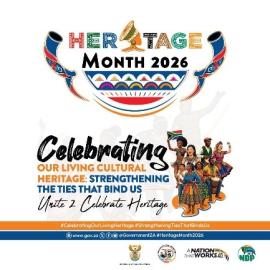
South Africans will on Thursday participate in National Heritage Day, with this year’s celebrations focusing on the role of living heritage in strengthening social cohesion, national unity and a shared sense of belonging.
Observed annually on 24 September, Heritage Day provides an opportunity for South Africans to recognise, celebrate and reflect on the country’s diverse cultural heritage.
This year’s National Heritage Day celebration will be held at Oudtshoorn in the Western Cape, under the theme: “Celebrating Our Living Heritage: Strengthening the Ties That Bind Us”, highlighting the importance of communities as custodians of heritage and the role of cultural practices, knowledge and traditions in fostering Ubuntu and mutual understanding.
Heritage Day forms part of the month-long Heritage Month programme, which provides an opportunity for South Africans to reflect on the country’s shared history, celebrate its cultural diversity and strengthen a collective sense of belonging.
September was declared Heritage Month in 1995.
The programme is grounded in the Constitutional values of human dignity, equality, non-racialism, non-sexism and Ubuntu.
Throughout Heritage Month, provinces and heritage institutions undertake activities aimed at promoting community participation, education, cultural expression and the transmission of heritage knowledge across generations.
South Africa’s heritage landscape has been shaped by a history of colonial dispossession and apartheid-era exclusion, which marginalised indigenous cultures, knowledge systems and forms of cultural expression.
Since the advent of democracy, the country has progressively reoriented the heritage sector towards greater inclusivity, redress and cultural democracy.
This approach is reflected in Constitutional protections as well as policy and legislative frameworks that recognise cultural participation, living heritage and indigenous knowledge systems.
As part of this year’s Heritage Month programme, the Living Human Treasures and Heritage Custodians Recognition Programme recognised individuals who preserve and transmit indigenous knowledge and cultural practices.
Other activities included intergenerational heritage dialogues, school heritage programmes, Indigenous Knowledge Systems and Heritage Symposia, as well as museum heritage education programmes.
These initiatives provided platforms for communities, heritage practitioners, traditional leaders, cultural workers, artists, indigenous knowledge holders, learners and young people to engage with and celebrate South Africa’s diverse heritage.
The Heritage Day celebrations are expected to further highlight the importance of preserving the country’s living heritage and ensuring that cultural knowledge and practices continue to be passed from one generation to the next. – SAnews.gov.za


