


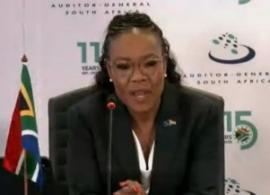
The Auditor-General of South Africa has urged government to intensify efforts to improve accountability and service delivery, while highlighting areas of progress that demonstrate the potential for meaningful reform across the public sector.
Releasing the 2024-25 General Report for national and provincial departments, public entities and legislatures in Pretoria on Thursday, Auditor-General Tsakani Maluleke, said there has been minimal improvement in audit results during the first year of the 7th administration.
Of the 417 auditees assessed, only 151 achieved clean audits.
Maluleke warned that many institutions, particularly high-impact auditees responsible for key sectors such as health, education, infrastructure and energy, continue to struggle with basic financial and performance management.
These entities account for the majority of government expenditure but remain unable to produce credible financial reports or comply with legislation.
The report found that 266 auditees failed to achieve clean audits and are responsible for managing 88% of the total expenditure budget. In addition, 45 auditees experienced regressions in their audit outcomes, including several high-impact institutions overseeing hundreds of billions of rand.
Maluleke emphasised that the audit process continues to play a critical role in strengthening transparency and accountability.
Through the implementation of the Material Irregularity (MI) process, tangible improvements have already been realised.
Financial losses amounting to R2.41 billion have been prevented or recovered, while practical interventions have led to better use of public resources.
These include in some instances where underutilised health facilities were brought back into operation and unused buses being converted into mobile libraries.
The report also highlights improvements in reducing irregular and wasteful expenditure compared to the previous year, suggesting that tighter controls and increased awareness are beginning to have an effect.
While challenges remain, some of the downward trends signal that corrective measures can yield positive results when consistently applied.
Maluleke stressed that strengthening institutional capability, governance and oversight will be key to unlocking further progress.
She pointed out that many of the shortcomings identified are not due to a lack of legislation or funding, but rather inconsistent implementation and weak accountability. Addressing these root causes, she said, would enable government institutions to better deliver on their mandates and improve outcomes for citizens.
Despite ongoing issues such as non-compliance with legislation, procurement weaknesses and infrastructure delays, the report underscores that solutions are within reach.
The successes achieved through the MI process demonstrate how decisive action, ethical leadership and effective oversight can lead to real improvements in service delivery and financial management.
Maluleke called on leaders across government to build on these gains and foster a culture of performance, transparency and accountability.
She reaffirmed the AGSA’s commitment to supporting the public sector through its audits and expanded powers, with the aim of strengthening public institutions and ensuring that resources are used effectively to improve the lives of South Africans. – SAnews.gov.za


