


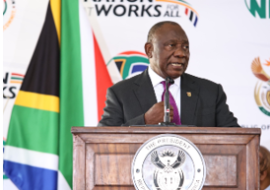
President Cyril Ramaphosa says government is reforming and strengthening the criminal justice system, rooting out corruption and building a police service and a prosecuting authority in which people can have trust and confidence.
“We call on all South Africans to be part of this work, to build communities, homes, schools and workplaces that are safe and secure,” President Ramaphosa said.
Speaking at the national Freedom Day celebration held at Dr Rantlai Molemela Stadium in Mangaung, President Ramaphosa said government is using the day to reflect, renew and reaffirm government’s commitment to the social contract entered into 32 years ago.
Freedom Day 2026 is commemorated under the theme: “Freedom and the Rule of Law: Thirty Years of Democratic Citizenship”.
“This is a compact that demands active citizenship, democratic oversight and a State that delivers justice, services, opportunity and dignity in return for public trust,” President Ramaphosa said.
The President said the Government of National Unity is determined to drive inclusive growth and job creation, reduce poverty and tackle the high cost of living, and build a capable, ethical and developmental State.
“This means we must address and overcome the many challenges facing South Africans today. Failing water infrastructure, collapsing municipalities and deteriorating services are not mere inconveniences. They directly affect the quality of daily life. They constrain the growth of businesses and the creation of jobs.
“Our resolve to strengthen local government provides an opportunity to transform municipalities, making them better run, more efficient and more responsive to the needs of our people,” the President said.
Transforming lives
President Ramaphosa said in the 32 years of democracy, South Africa has built a progressive constitutional democracy firmly anchored in the rule of law, with an independent judiciary that serves as a guardian of the rights of all.
“We have expanded access to healthcare, housing, education, water and electricity on an unprecedented scale.”
President Ramaphosa said government has also transformed the education system that was used to perpetuate oppression to ensure universal access to education by introducing no-fee schools to expand access to education to children from poor households.
“Our National School Nutrition Programme feeds more than nine million learners every single day. Through the National Student Financial Aid Scheme, we have made tertiary education accessible to students from low-income households.”
The President said since the dawn of democracy, government has steadily worked to expand access to quality health care for all.
“We have built clinics and hospitals, provided free health care to pregnant women and young children, reduced child mortality and increased life expectancy.
“Now we are working together to establish the National Health Insurance so that every person in this country has equal access to quality health care, regardless of their ability to pay.
“We are making progress on land reform, restoring land to many of those dispossessed since the introduction of the 1913 Natives Land Act and continuing to support its productive use.”
The President said 32 years ago, more than 20 million South Africans participated in the first democratic election that was peaceful, free and fair.
President Ramaphosa said it is an honour to mark that occasion in Bloemfontein, where the flame of freedom was lit.
“It was here in Mangaung that the African National Congress was born in 1912, bringing together for the first time people from across our country to stand against oppression and dispossession.”
President Ramaphosa said the Free State is a province that suffered the cruelty of colonialism and apartheid.
“Here in Bloemfontein and in towns across the province, tens of thousands of Afrikaners and Africans were held in inhuman conditions in British concentration camps during the Anglo-Boer War.
“Many thousands, mostly women and children, died. Their suffering stands as a shared, though unevenly remembered, chapter of South Africa’s past, one that calls for remembrance, honesty and humanity. This is a province with a history of courageous resistance.
“Women from the then Orange Free State were among the first to rise against the extension of pass laws in 1913, with protests breaking out in Jagersfontein, Winburg and Bloemfontein.
“They were arrested and imprisoned and their families were left without caregivers. Instead of being broken, the women of the Orange Free State became more determined because they would not accept a system that denied them dignity and freedom,” the President said.
President Ramaphosa said it was the people of the Free State province that took Mama Winnie Mandela into their hearts and gave her comfort when she was banished to Brandfort in 1977.
“When Mama Winnie Mandela was banished to Brandfort, the apartheid rulers thought they were isolating her and breaking her spirit and influence.
“The people of Brandfort here in the Free State did something remarkable: they did not let that voice fade. They carried it. They strengthened it. And they made it their own. They united in compassion and that became stronger than the system of a apartheid itself.”
President Ramaphosa said 30 years ago, the Constitution of the Republic was signed into law and became the "birth certificate" of the nation.
“Our Constitution, which is widely regarded around the world as one of the most progressive, visionary and influential constitutions ever adopted, is a powerful promise about freedom and stands as our collective shield protecting the freedom our people fought for.
“We stand here today not only as citizens of a democratic nation, but as custodians of a hard-won legacy of freedom -- a legacy won in struggle. A legacy shaped by sacrifice, courage and an unbreakable belief in in freedom and justice,” the President said.
Celebrating democracy
In her welcome remarks, Free State Premier Maqueen Letsoha-Mathae said Freedom Day is an important day in the history of South Africa.
“This day ushered in a new dawn, It was the day when South Africans showed their determination for a new government."
Letsoha-Mathae said since the President’s visit to the province in December, much has been done to improve people’s lives.
“We have doubled our efforts to improve people’s lives.”
The Freedom Day celebration was attended by senior government officials, Cabinet Ministers, politicians and members of the public, who came in their numbers.
Freedom Day 2026 marks the 32nd anniversary of South Africa’s first democratic elections held on 27 April 1994 and stands as a testament to the country’s journey towards democracy, justice, equality and human dignity.
The commemoration highlights three decades since the adoption of the Constitution and underscores the importance of constitutional supremacy, the rule of law, and democratic citizenship in shaping South Africa’s future.
This year’s national event takes place within the context of several significant national milestones, including the 30th anniversary of the adoption of the Constitution, 70 years since the Women’s March if 1956, and 50 years since the Soweto youth uprising.
These milestones continue to shape South Africa’s democratic journey by inspiring continued transformation. – SAnews.gov.za


