


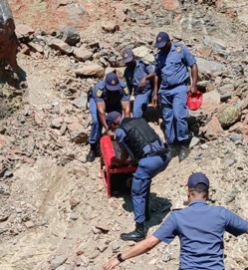
Deputy President Paul Mashatile says government is intensifying intelligence-driven operations to combat illegal mining in parts of Gauteng, including communities in the East and West Rand.
Mashatile was responding to questions in the National Council of Provinces (NCOP) on Thursday regarding illegal mining in the Gugulethu and Sporong informal settlements in Randfontein.
He said illegal mining poses a serious threat to communities and the economy, often linked to transnational criminal syndicates, illicit financial flows, undocumented migration and the proliferation of illegal firearms.
“As a result, government is intensifying intelligence-driven operations under initiatives such as Operation Vala Umgodi. This includes the deployment of specialised units, disruption of supply chains, arrests of perpetrators and syndicate leaders, and seizures of equipment and contraband, in cooperation with the National Prosecuting Authority (NPA) to secure convictions,” he said.
Mashatile said the South African Police Service, the Directorate for Priority Crime Investigation, the Department of Mineral Resources and Energy and the Department of Home Affairs are working together to combat the problem.
The Deputy President said government is also addressing the threat posed by the infiltration of illegal and counterfeit goods, which continue to undermine South African jobs and industrial competitiveness, through the 12‑dimensional National Illicit Economy Disruption Programme.
“Government has secured funding to commence the implementation of this programme, which includes targeted enforcement in high‑risk sectors experiencing major revenue losses and entrenched syndicate activity, notably illegal mining, fuel smuggling, and port‑linked illicit trade,” he said.
In addition, Mashatile said the South African National Defence Force has been deployed to support police operations aimed at curbing illegal mining and gang-related violence.
This deployment enhances NATJOINTS coordination and strengthens continuous monitoring efforts to prevent any resurgence of criminal activity.
“The President’s directive underscores government’s determination to confront these urgent challenges, and we appreciate his decisive leadership in this regard,” the Deputy President said.
Measures to curb corruption in SAPS
The Deputy President said government continues to strengthen measures to detect and prevent corruption within the South African Police Service (SAPS).
He said the cluster remains central to coordinating government’s response to crime, violence and corruption within the criminal justice system.
Measures implemented to curb corruption include the establishment of the Anti-Corruption Task Team in 2010 to investigate high-level graft, as well as the rollout of technology-driven case management systems to reduce manual interference and vulnerabilities.
“Operational reforms have also been undertaken to reduce opportunities for corruption, including improvements to crime scene management, enhancement of investigative capacity, and the establishment of specialised units such as the Anti-Gang Unit and the Economic Infrastructure Task Teams,” he said.
To encourage reporting of wrongdoing, the police service has also enhanced whistle-blower protection through National Instruction 18 of 2019, enabling safe reporting through platforms such as the National Anti-Corruption Hotline and internal ethics reporting systems.
Mashatile said other oversight bodies involved in detecting corruption include the Independent Police Investigative Directorate, the Public Protector of South Africa, and the Auditor-General of South Africa.
SAPS continues to strengthen internal detection mechanisms through vetting and screening of priority personnel, including members of Crime Intelligence, supply chain management and the Directorate for Priority Crime Investigation.
“These measures are supported by lifestyle reviews and financial disclosure analysis, including reactive lifestyle audits where allegations are received. Where serious allegations of fraud and corruption arise, forensic audits and criminal investigations will follow, and those found guilty will be prosecuted,” he said.
To strengthen policing capacity, the President announced at the State of the Nation Address last month the recruitment of 5 500 additional police officers, alongside strengthened firearm legislation enforcement.
Further, the President has directed the Acting Minister of Police and the National Commissioner to establish a special task team to investigate criminality involving senior SAPS members, following interim findings of the Madlanga Commission. – SAnews.gov.za


