


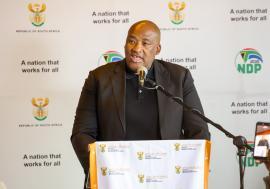
Government is calling on families whose loved ones died, disappeared, or were buried in Angola during the liberation struggle to come forward and register with the South African Heritage Resources Agency (SAHRA).
This comes after government officially launched the Angola phase of South Africa's Exile Repatriation Programme on Friday in Pretoria at a media briefing hosted by the Department of Sport, Arts and Culture (DSAC) and SAHRA.
The Exile Repatriation Project gives effect to the recommendations of the Truth and Reconciliation Commission (TRC), which called on government to continue tracing people who disappeared in political circumstances between 1960 and 1994.
Cabinet approved the initiative in Angola in March 2026 as part of government's Five-Year Exile Repatriation Plan, which gives effect to the Memorandum of Understanding signed between the Governments of South Africa and Angola in December 2024 under the Roads to Independence: African Liberation Heritage Programme.
Minister of Sport, Arts and Culture Gayton McKenzie said the programme is about restoring dignity to families who have spent decades without answers.
"There is a woman in this country who was a girl when her brother walked out of the family home. She never saw him again. Today there are hundreds of families like hers. We are here to tell them that the waiting is coming to an end,” McKenzie said.
The Minister explained that Angola has been identified as the immediate focus because it holds the largest concentration of South Africans who died in exile during the liberation struggle.
Government has already identified more than 400 possible burial sites across various regions of Angola, although the recovery process will remain complex due to landmines, overgrown and unmarked graves, deteriorated remains, difficult terrain and limited historical records.
The Minister acknowledged that despite the use of advanced forensic science and DNA analysis, some remains may never be recovered or identified.
McKenzie said applications are now open for families seeking the exhumation, forensic identification and repatriation of relatives who died in exile in Angola.
Government has emphasised that the programme is open to all South African families, regardless of political affiliation or organisational membership.
Families can submit applications online through the SAHRA Exile Repatriation Portal at https://www.sahra.org.za/exile-repatriation/, where they can complete the application form, access a step-by-step application guide, download the repatriation request form and obtain detailed information about the programme.
Families requiring assistance may also register telephonically or in person at SAHRA offices, Freedom Park, provincial Department of Sport, Arts and Culture offices and through military veterans' structures, where assistance will be provided in their preferred language.
"Every family that applies will be supported. Where physical remains cannot be recovered, government will facilitate spiritual repatriation so that no family is left without an opportunity to honour their loved one,” McKenzie said.
Minister of Defence and Military Veterans Angie Motshekga described the initiative as a national obligation to honour those who sacrificed everything for South Africa's freedom.
"This work is far more than an administrative exercise. It is a national duty. It is about restoring dignity to those who sacrificed everything for the freedom we enjoy today,” Motshekga said.
She said recovery teams continue to navigate mine-affected areas, unmarked burial sites, deteriorated remains and changing landscapes, making each recovery mission technically demanding and requiring close cooperation between South Africa, Angola and specialist forensic teams.
Motshekga urged families to come forward, emphasising that every testimony, document and DNA (deoxyribonucleic acid) sample strengthens government's ability to identify and return another liberation hero to their family. -SAnews.gov.za


