


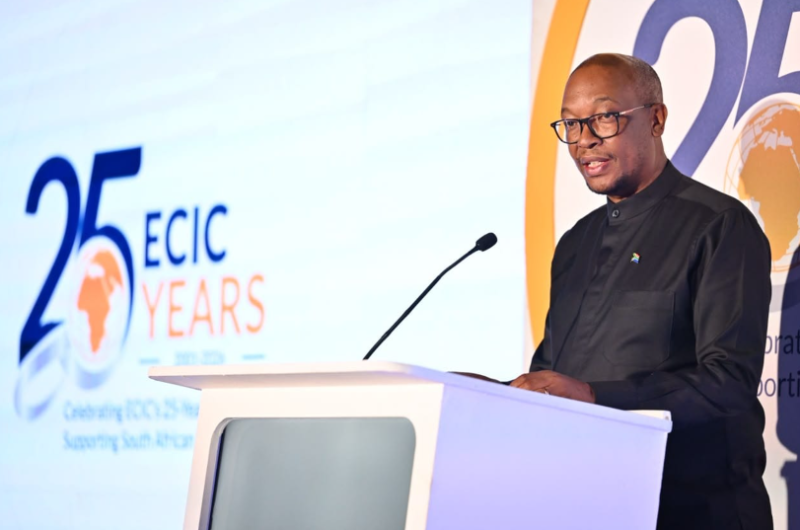
Trade, Industry and Competition (dtic) Minister Parks Tau says the Export Credit Insurance Corporation (ECIC) has reached a significant milestone, having unlocked R1.06 trillion in capital for various sectors including rail, mining, power, manufacturing, and telecommunications.
The Minister was speaking at the ECIC 25-year legacy celebration in Sandton, Gauteng, on Saturday.
Established in 2001 under the Export Credit and Foreign Investments Insurance Act, 1957 (as amended), ECIC provides political and commercial risk insurance to South African exporters of goods and related services. It operates as a self-sustained, state-owned national export credit agency.
According to Tau, key metrics include the creation of over 87 000 jobs, a contribution of R21.7 billion to gross domestic product (GDP), and the generation of approximately R7.9 billion in tax revenue.
“The current portfolio value of the Corporation is now sitting at R33.2 billion. Notable supported projects include MTN in Nigeria, Vodacom in Tanzania, the Konkola copper mines in Zambia and gold mines in Tanzania.
“Sasol’s natural gas pipeline from Mozambique, the Cenpower project in Ghana, the Maputo Port expansion and the Nacala Rail Corridor. Each one carried South African engineering, construction and services into new markets,” the Minister explained.
To navigate shifting global trade patterns and rising geopolitical risks, the ECIC is implementing a butterfly trade strategy aimed at diversifying market exposure beyond its current concentration, where 88% sits in just three countries.
“The ECIC intends to expand its footprint across the Atlantic and Indian Oceans while deepening involvement within the African continent through the African Continental Free Trade Area (AfCFTA) and its Class A membership of Afreximbank to expand trade finance for AfCFTA transactions,” the Minister said.
He added that there is a focus on ensuring private capital flows toward opportunities by utilising credit lines and guarantees to crowd in commercial lending rather than replacing it.
“Second, capital must follow the opportunity. Plans do not build factories and trade agreements do not finance exports. Capital does. Government should not replace commercial finance. ECIC’s role is to share and absorb risk so private capital can participate.
“That is why government is advancing work towards a South African Export-Import Bank. It will not compete with commercial banks. It will fill the gaps the market cannot, through credit lines, guarantees and risk-sharing that crowd in commercial lending,” Tau added.
Tau stated that for transformation to deepen, South Africa’s export future cannot depend only on large projects and established companies.
He said ECIC’s expansion into short-term export credit insurance will help small and medium enterprises, black industrialists and emerging manufacturers enter new markets.
“The ECIC is committed to continue supporting black-owned companies in the rail sector, and to drive transformation through its investment activities.
“And to South African exporters, especially those facing uncertainty in traditional markets, government stands with you. We will defend important markets, open new ones, deepen regional value chains and strengthen the institutions that put capital behind our industrial ambitions,” he said. – SAnews.gov.za


