


By Khaye Nkwanyana
When President Cyril Ramaphosa initiated a new, coordinated, single-planning dispensation in intergovernmental relations—the District Development Model (DDM) — in 2019, many critics rejected it as nothing more than another layer of coordinating structures. They argued that it risked duplicating existing systems and undercutting local government autonomy without solving core administrative weaknesses.
Related to this was the argument that municipal failures stem from weak governance, corruption and a lack of technical skills, not a lack of national coordination.
These counterarguments tell only part of the story. They cannot simply be applied across all 44 district municipalities, responsible for a plethora of local municipalities, including secondary cities, or across all eight metropolitan municipalities.
From my experience within the DDM system, the problem is not only what happens inside a municipality. It is also how the three spheres of government plan, budget and act—or fail to act—together.
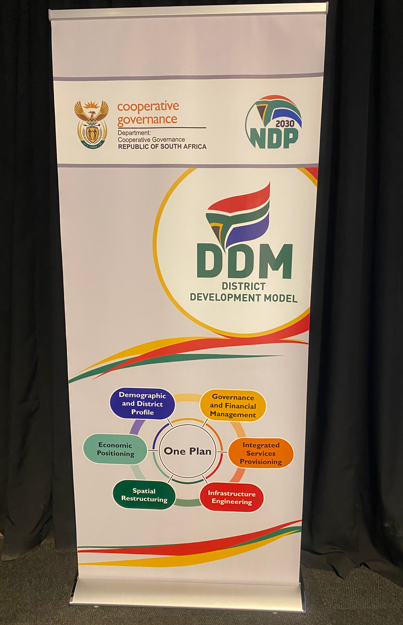
Anchored in planning by the three spheres of government at district level, the logic behind the DDM is to cut through fragmented, siloed government operations. It brings national, provincial and local government, alongside business and community stakeholders, into a common planning space. Its core mantra is clear: “One District, One Approach, One Plan, One Budget”.
This is not coordination for its own sake. It is about directing the resources and capabilities of government towards the places where people live and where development must happen.
Some have questioned whether the DDM amounts to an encroachment by other spheres on local government, undermining its relative autonomy. If anything, the DDM gives palpable expression to the constitutional principles of cooperative governance found in Chapters 3 and 7, including Sections 41 and 154. The spheres of government are distinct, yet interdependent and obliged to support one another. Municipal autonomy cannot mean leaving municipalities to confront complex development challenges on their own.
Working under the auspices of the Deputy Minister of Trade, Industry and Competition from 2019 to 2024, Dr Nomalungelo Gina, I was privileged to coordinate her DDM work as the national champion of Namakwa District in the Northern Cape. As a co-convenor of the Technical Hub, I worked very closely with Namakwa District Municipal Manager Christiaan Furton, local municipal managers, local economic development managers, provincial heads of department, Cooperative Governance and Traditional Affairs (COGTA) officials and business leadership.
Together, we became an important kernel of planning. We harmonized local, provincial and national plans directed towards the district, debated its development needs and conceived catalytic infrastructure projects to drive district-based growth. On this basis, we consolidated one budget against which one District Plan could be pursued over the immediate, medium- and long-term horizons.
The Political Hub, chaired by the national champion and supported by the provincial champion, mayors and business leadership, interrogated the Technical Hub’s work and decided on its recommendations, including adoption of the One Plan.
We lifted up nine strategic and catalytic projects, the majority of which required national line departments to get involved. Our task in the national champion’s office was to coordinate with those departments, while the Deputy Minister engaged the relevant Ministers. District priorities could no longer remain local pleas, passed from one office to another. They had become a collective agenda demanding the attention of the three spheres.
Against the backdrop of COVID-19, we held many virtual meetings. Once the President lifted travel restrictions, we were in Namakwa for a week every third month. There is no substitute for being on the ground: sitting with local leadership, confronting the obstacles and working through what must be done.
We succeeded in securing the designation of the Namakwa Special Economic Zone (SEZ). We facilitated engagements that led to a decision to develop the Boegoe Baai deep-sea port for future mineral exports from the Northern Cape. We also pursued discussions on a railway network connecting the mineral belt through the SEZ, Vedanta Zinc at Aggeneys and Copper 360 at Okiep, all the way to Boegoe Baai in the Richtersveld municipal area. This was the kind of catalytic infrastructure thinking needed to drive district-based growth.
Alexkor handed over its old town, Alexander Bay, and its assets to the district. We had stimulating engagements on how to rejuvenate the town and surrounding communities along the Atlantic Ocean, overlooking Namibia. In Port Nolloth, our focus was the revival of the fishing economy, which had collapsed after once being a driver of local livelihoods and business. We engaged Public Works on infrastructure renewal, including the jetty and fish-processing factory, and the department responsible for forestry, fisheries and the environment on fishing permits, cooperative training and the purchase of fishing boats. The Chinese offered to support the revival of Port Nolloth under the small-harbour programme. These engagements were still at an early stage when the sixth administration came to an end.
In the seventh administration, the Deputy Minister was appointed to the Department of Science, Technology and Innovation, and the President appointed her as champion of uMkhanyakude District in KwaZulu-Natal. We came into a district that, in our experience, had not enjoyed a sustained DDM championship during the sixth administration. This meant starting from scratch: bringing the leadership together, building the working structures and putting a common district agenda on the table.
I want to commend the Department of Science, Technology and Innovation for taking a decision not merely to support the Minister and Deputy Minister in their championship roles, but to make DDM work part of the department’s own work across all 44 districts and eight metropolitan municipalities.
A Chief Directorate coordinates this work, seeking to infuse technology and innovation programmes into municipal development. Senior managers have been appointed as technical champions in districts and metros and report quarterly on their work. DDM work is being incorporated into departmental targets and senior managers’ individual performance assessments. This is how the model gains institutional muscle, rather than remaining the responsibility of political champions alone.
In March 2025, KZN COGTA rated uMkhanyakude last on DDM work. By July 2026, it was rated number one, after concluding and adopting its One Plan and One Budget. The district identified 11 catalytic projects to stimulate growth, ranging from agro-processing and aviation and logistics to tourism and property development.
In October 2026, through DDM determination, an Investment Gala Dinner brought together investors, development finance institutions, private banks and corporate leaders, where these investible projects were presented. A district that had been trailing at the end was now putting its development ambitions before investors.
My experience of working within the DDM system depicts a glowing picture of a mechanism that cuts through red tape and silos, and makes development a collective responsibility of the three spheres of government. The enrichment of ideas through technical expertise from national and provincial departments empowers local officials.
Project preparation and design have become a collective endeavour, easing the capacity burdens that municipalities too often carry alone. This brings a new sense of agency and urgency to work that can otherwise remain trapped between departmental mandates.
It is high time that government departments take DDM work beyond Ministers and MECs, deploy officials to support it and make provision for the budgets that district priorities require. We cannot call for municipalities to deliver and then leave them to fight alone for the expertise, infrastructure and resources that sit elsewhere in government. The DDM provides a vehicle for bringing those capabilities together. Departments must put their weight behind it.
Local government is the sphere of gravity for service delivery. Its impact is so direct that people experience it in their daily lives—in water, roads, livelihoods and the prospects of their towns. For me, the DDM is not an abstract planning exercise. It is a practical instrument for breaking the silos that hold development back and directing the collective strength of government towards the people. That is why it deserves to be strengthened, not dismissed.
*Nkwanyana is Head of Office for Deputy Minister Gina at the Department of Science, Technology and Innovation


