


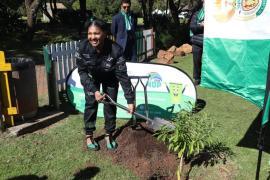
The Department of Forestry, Fisheries and the Environment (DFFE) is piloting an initiative to plant trees around wastewater treatment plants across the country to help mitigate odours generated by treatment processes and protect surrounding communities and the environment.
“The Wastewater treatment plants are essential for protecting public health and water resources; however, they are often associated with persistent odour emissions that negatively affect surrounding communities,” Deputy Minister of Forestry, Fisheries and the Environment Bernice Swarts said on Monday in Pretoria.
The initiative will begin at the Ekurhuleni Water Care Company (ERWAT), which operates 19 wastewater treatment works.
According to Swarts, odours generated from processes such as sludge handling, anaerobic decomposition and chemical reactions continue to present environmental and social challenges for nearby communities.
“These odours can lead to neighbouring community discomfort, complaints, and reputational risks, particularly in densely populated areas within the City of Ekurhuleni.
“Inadequate odour mitigation measures may also weaken public trust and reduce the perceived acceptability of wastewater infrastructure, despite its critical role in service delivery.
“It is therefore important to develop green spaces through tree planting in and around the wastewater treatment plant, which offer buffers between the communities and add to the general wellness of the environment,” Swarts said.
The Deputy Minister was addressing the launch of the Presidential One Billion Trees Programme, which seeks to mobilise South Africans from all walks of life - including government, the private sector, business, interfaith formations, diplomatic corps, traditional leaders, Non-governmental organizations (NGOs), youth formations and communities - to plant trees as part of efforts to mitigate the effects of climate change.
The launch follows the success of the 2025 One Million Trees Campaign, during which more than 1.3 million trees were planted across the country on Heritage Day in September 2025.
The planting of trees in residential settlements, recreational facilities, parks and open spaces has been identified as a critical environmental management intervention to address the effects of climate change.
The Deputy Minister underscored that greening is not only an environmental responsibility but also a social and economic necessity.
“As a country, we continue to confront the growing challenges of climate change, environmental degradation, biodiversity loss and food insecurity. These challenges affect us all, but they weigh most heavily on the poor and vulnerable people,” Swarts said.
She added that biodiversity loss also disproportionately affects the country’s poorest people, particularly in rural areas, who depend directly on natural ecosystems for food, water, medicine, and livelihoods.
“As ecosystems degrade, these communities face reduced food security, decreased income, and increased vulnerability to natural disasters and climate change, exacerbating inequality," the Deputy Minister said.
She announced that the government plans to plant 10 million trees across the country on Heritage Day this year, working together with all South Africans.
“These trees will be planted across the country in our safe spaces such as schools, community parks, health facilities and in our residential spaces. It is therefore the President’s call that all South Africans participate in this programme by planting trees on Heritage Day,” she said.
The Deputy Minister called on all South Africans, including all spheres of government, organised business, organised labour, civil society and all citizens, to participate in the campaign to plant Ten Million Trees on Heritage Day in September 2026 as part of the Presidential One Billion Trees Programme.
She noted that properties that have been greened using trees and other plants have realised increased property values.
“This, in turn, ensures that Municipalities can collect more rates, thereby enabling increased service delivery in that particular local authority,” she said.
The Deputy Minister explained that the participation of municipalities will improve planning at the municipal level, enabling the identification of projects that can contribute to mitigating climate change, such as repurposing dumping sites into safe and peaceful parks.
“Trees also frequently bear the burden of pollution and industrial waste, especially in densely populated areas and industrialised zones with high levels of air pollution.
“Greening is thus inseparable from the pursuit of spatial justice in the context of a South Africa where the under-development of lower-income communities is the product of historical processes rooted in segregation
“Let us once again come together in the spirit of shared responsibility and common purpose. Let us plant not only trees, but the seeds of hope, dignity and lasting change in every community across our nation,” Swarts said. -SAnews.gov.za


