


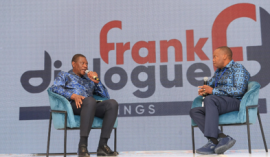
Deputy President Paul Mashatile says that while Broad-Based Black Economic Empowerment (B-BBEE) has faced implementation shortcomings, it has led to measurable progress in economic inclusion, particularly through the growth of the Black middle class and advancement in industries such as mining and finance.
Speaking at the second Frank Dialogue on the future of B-BBEE in Durban on Saturday, Mashatile stressed the importance of addressing historical inequities to foster inclusive growth.
“I fully agree with the prevailing view among panellists that it is crucial to address historical inequities for fostering inclusive growth, emphasising the need for transformative policies such as B-BBEE,” he said.
However, the Deputy President acknowledged that the implementation of B-BBEE has faced inconsistencies and various hurdles over the years, some of which are still evident today.
“Economic opportunities remain largely concentrated, accompanied by significant skill deficits that impede the policy’s effectiveness. Furthermore, procurement processes often marginalise Black-owned enterprises, contradicting B-BBEE’s objectives.”
He warned that empowerment must be substantive rather than symbolic.
“Policy legitimacy depends on outcomes. Where empowerment becomes paper-based rather than production-based, where fronting occurs, and where exclusion persists, trust is weakened.”
Mashatile called for firmer and more consistent enforcement, supported by credible oversight, to close gaps exploited by fronting practices and aligning agency interests more closely with the principles of B-BBEE.
Reform
The Deputy President warned against conflating governance failures of implementation and broader governance issues with the intrinsic purpose and design of B-BBEE.
“It is misleading to attribute complex macroeconomic outcomes solely to the policy while ignoring other pressing factors, including structural constraints. Abandoning B-BBEE is not an option. The path forward is reform, strengthening and disciplined implementation.”
Government is undertaking a two-phase review of the B-BBEE framework, led by the Department of Trade, Industry and Competition.
The aim, he said, is to refine and reinforce the policy so that it drives transformation, reduces corruption, and promotes inclusive, broad-based growth.
Mashatile referred to the BEE Commission’s 2022 National Status Report, which highlights annual certification data that tracks improvements in ownership, management control, skills pipelines, and supplier development, suggesting that transformation is advancing, albeit unevenly, rather than stagnating.
“This incremental upward trend is consistent with the Government's stance that B-BBEE is a vital policy tool for promoting the meaningful involvement of historically disadvantaged groups, specifically women, youth, and persons with disabilities, in sectors where inequality persists,” the Deputy President said.
He emphasised that B-BBEE is also a moral obligation rooted in democratic processes. It aligns with Section 9(2) of the Constitution, which allows corrective actions to promote equality and redress discrimination.
The Deputy President linked empowerment policy directly to South Africa’s unemployment crisis.
According to Statistics South Africa, the official unemployment rate stood at 31.4% in the fourth quarter of 2025, with 7.8 million people unemployed. The expanded rate, including discouraged work-seekers, reached 42.1%, while youth unemployment among those aged 15–24 stood at 57%.
On poverty and inequality, the World Bank estimates South Africa’s Gini coefficient at around 63, with the bottom 40% of the population accounting for just 11.5% of income, compared to nearly 60% for the top 20%.
“Transformative policies such as Affirmative Action, Employment Equity, and B-BBEE remain absolutely necessary because exclusion remains measurable and unabated. Thus, these transformative policies offer an opportunity to shape a future where everyone has equal opportunities, despite not starting from an equal footing.
“These policies are essential in addressing the significant wealth gap between Black and White South Africans, highlighting the need for race-based laws to ensure a more equitable playing field. It is through proper implementation that we can also address unemployment and youth exclusion in the key economic activities,” the Deputy President said.
He also pointed to persistent representation gaps, noting that persons with disabilities remain at around 1% of workforce representation, underscoring slow progress without stronger delivery mechanisms.
The Deputy President said urgent attention is required to deepen Black participation in key sectors, including agriculture, mining, finance, and manufacturing.
Citing economist Wandile Sihlobo’s book “A Country of Two Agricultures,” he noted that Black farmers account for only about 10% of South Africa’s commercial agricultural output.
“This stark figure tells us that our growth agenda must have a deliberate bias towards the empowerment of Black farmers,” he said.
He outlined how B-BBEE tools, including ownership, skills development, preferential procurement and enterprise development, can be leveraged to support land reform, open markets, and integrate emerging farmers into value chains.
He further referenced findings by the Competition Commission of South Africa showing persistent market concentration, with small and medium enterprises representing 95% of firms but contributing only 24% of turnover, compared to 76% from large firms.
“Empowerment must be about opening value chains and expanding productive inclusion, not only compliance,” he said. – SAnews.gov.za


