


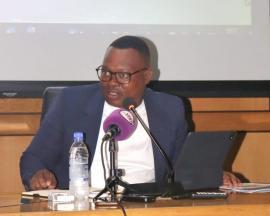
Water and Sanitation Deputy Minister Sello Seitlholo has urged the Rustenburg and Moses Kotane Local Municipalities, the Bojanala District Municipality and Magalies Water to work together to address infrastructure failures and service delivery constraints affecting reliable water supply to communities.
Seitlholo made the call during a stakeholder meeting held at the Rustenburg Civic Centre Council Chamber on Monday. The meeting brought together key stakeholders responsible for water services in the area to assess the status of ongoing interventions that are currently underway.
Among the issues discussed included disruptions to bulk water supply and wastewater management challenges contributing to water pollution in Rustenburg and Moses Kotane Local Municipalities.
The Deputy Minister emphasised the need for stronger coordination, accountability and practical, time-bound solutions to restore operational stability across affected systems.
Seitlholo expressed serious concern about contamination in the Vaalkop Dam, where alien invasive Salvinia plants have spread extensively, covering almost the entire surface of the dam.
He said the presence of Salvinia plants significantly affects the ecological balance of the water resource by blocking sunlight, reducing oxygen levels, damaging aquatic ecosystems, and complicating water abstraction processes.
Seitlholo highlighted the impact of dysfunctional wastewater treatment works in both Rustenburg and Moses Kotane, which have contributed to deterioration of water quality in the area.
The Department of Water and Sanitation has since taken regulatory action by issuing notices and directives under the National Water Act to address the discharge of untreated sewage into water resources.
Seitlholo stressed that the department has a clear mandate in wastewater management, sanitation and pollution control, but must intervene when broader water service challenges threaten the sustainability of water resources.
“Our responsibility is to ensure that our water resources are protected and managed properly. When wastewater treatment systems fail and untreated, sewage enters our water bodies, it undermines the very resources that communities depend on,” the Deputy Minister said,” he said.
On operational challenges, Seitlholo noted that the Kortbegrip Reservoir System is currently operating with only one functional pump instead of three, significantly limiting its water supply capacity.
He raised concerns about persistent electricity supply challenges at the Phatsima Pump Station, which have been ongoing since 2023, and remain a major constraint to water distribution.
The Deputy Minister also raised concern about the Tlhabane Reservoir under the Pilanesberg Phase 2 Project, which remains non-operational because the Mafenya Pump Station has not yet been energised. This is despite the project having already been officially unveiled.
He further pointed out that the decommissioning of the Bospoort Reservoir has placed additional pressure on the remaining 35-megalitre reservoir, which is unable to meet growing water demand.
In addition, Bospoort Plant 3 is operating with only three of the required five pumps, resulting in frequent operational failures and reduced supply capacity.
Frequent pipe bursts along the Monakato pump line were also identified as a major challenge, often causing water supply disruptions lasting between two and three days.
“These cumulative challenges have resulted in recurring water interruptions, growing frustration among communities, and negative consequences for economic activity and basic service delivery,” the Deputy Minister said.
Seitlholo noted that the National Water Act and the Water Services Act clearly define responsibilities of the various institutions involved in water management.
While the department is responsible for managing water resources and overseeing bulk water supply, local municipalities serve as Water Services Authorities responsible for distributing water to communities.
“Once water is supplied to municipalities, the responsibility for its distribution and management lies with the local authority. Magalies Water provides bulk water in accordance with its licence conditions, but municipalities must ensure that the water reaches households and communities through properly functioning infrastructure,” he explained. – SAnews.gov.za


