


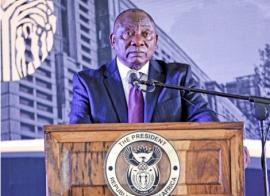
President Cyril Ramaphosa has praised the Constitutional Court for its critical role in deepening democracy, advancing human rights, and promoting national cohesion and reconciliation over the past three decades.
Speaking at a special event marking the 30-year anniversary of the court’s establishment on Friday in Johannesburg, President Ramaphosa described the apex court as not only a legal institution but a “noble symbol of our democratic order; both immortal and legal compass”.
“This moment calls not only for celebration, but also for reflection, for recommitment, and for a renewed vision of constitutionalism in action in South Africa,” the President said.
Reflecting on the court’s founding in 1994, the President noted its symbolic location, built on the ruins of the infamous Old Fort prison in Braamfontein as a reminder of South Africa’s painful past and a testament to the transformative promise of constitutional justice.
“This court was established on the ruins of an oppressive legal system and was built on the grounds of a former prison, embodying the hope that law could become an instrument of justice rather than repression,” he said.
Recalling the adoption of the Constitution on 8 May 1996, President Ramaphosa, who then chaired the Constitutional Assembly, likened the document to “our new nation’s birth certificate”, describing it as a legal foundation that affirms dignity, equality, and freedom for all South Africans.
“Just like a person cannot enjoy their rights without a birth certificate, without the Constitution our country would be cast adrift, and be vulnerable to the excesses of unchecked power.
“We celebrate the existence of this court over the 30 years in which it has defended our democratic vision as set out in our birth certificate, our Constitution. This court has been the guardian, watching over our nation’s legal health just as a parent would attend to the health of their growing child,” he said.
Building a culture of rights
The President credited the court for cultivating a rights-based culture by issuing transformative and far-reaching judgments, including in S v Makwanyane that abolished the death penalty; the Grootboom case that centred on the right to housing; and Minister of Health v Treatment Action Campaign that dealt with the right to healthcare and access to HIV/Aids treatment.
“The Constitutional Court has developed a rich and transformative jurisprudence. These judgements are not merely legal decisions - they are decisions that have changed lives, shaped our society, and strengthened our democracy,” he said.
He praised the court’s jurisprudence for affirming the rights of the vulnerable, including same-sex couples, women in traditional marriages, children, the poor, and the infirm.
“The court’s judgments have advanced the rights of same-sex couples, of women in traditional marriages, of the sick and infirm, of children, of voters, and of the most marginalised members of society. They have affirmed that dignity, equality and freedom are not reserved for the powerful, but guaranteed to all,” he said.
He acknowledged the international legal influences that helped shape South Africa’s Constitution, with insights drawn from jurisdictions such as Canada, Germany, India and the United States.
Quoting former Justice Albie Sachs, President Ramaphosa said: “We borrowed ideas, concepts and structures from Canada, Germany, India and the United States, but made them South African.”
Challenges and shortcomings
While lauding the court’s role, President Ramaphosa also acknowledged ongoing challenges in realising the full promise of constitutionalism, particularly in the delivery of socio-economic rights.
“It will forever remain a blight on our democracy that the applicant in the ground-breaking Grootboom judgment, Ms. Irene Grootboom, died in 2008 without her dream of a decent house being fulfilled,” he said.
He stressed that citizens should not have to resort to litigation to claim rights that the state is obligated to fulfil.
“There is a disconnect between the promise of our Constitution and the lived realities of South Africans. Persistent inequality, threats to judicial independence, lack of implementation of court orders, and erosion of trust in institutions remain pressing challenges,” he warned.
Commitment to the judiciary
President Ramaphosa reaffirmed government’s commitment to supporting the judiciary and upholding its independence. He cited budget allocations to improve court services, judicial education, and infrastructure as part of efforts to bolster the judiciary’s effectiveness.
“To ensure that the judiciary execute their duties independently, effectively, and with dignity - government must and will provide a range of institutional, infrastructure, financial, administrative, and legal support. The support is crucial to maintaining judicial independence, which is a cornerstone of democracy and the rule of law,” he said.
He confirmed that a joint committee between the executive and judiciary will finalise an action plan in the coming weeks to strengthen the judicial system and institutional independence.
Tribute to pioneers
The President paid tribute to current and former Constitutional Court Justices, legal clerks, scholars, and practitioners who have contributed to the court’s legacy.
Among those honoured were retired Justices Albie Sachs and Kate O’Regan, who were part of the inaugural bench. He also recalled stories shared by his legal advisor, Advocate Nokukhanya Jele, who clerked for the court in its early days, sharing memories of operating in cramped temporary offices, and of rain leaking onto legal papers during the Court’s relocation to its current premises in 2004.
“For all who had the privilege of being part of those early days working at the court, there was a sense of elation at being part of history in the making. Of being part of something far greater; something that all one’s years of legal training had prepared one for.
“As a nation we can be nothing short of immensely proud of the constitutional court, of what it has achieved, and of its ongoing and pre-eminent role in our society,” he said.
Looking ahead
President Ramaphosa called on legal professionals, government leaders and citizens alike to recommit to the Constitution and its values of accountability, ethics, and public service.
“Thirty years on, the Constitutional Court remains a beacon of democracy. A compass for our future journey. May it continue to stand as a testament to justice, accountability, and the resilience of the South African people,” the President said.
He added that the country faces many challenges including poverty, inequality, joblessness and under-development.
“Yet we move forward as a collective with confidence, fortified by the knowledge that that you, the guardians of our constitutional order, are with us, alongside us, guiding us.
“As we look to the next 30 years, let us ensure that the Constitutional Court remains a living institution—responsive, principled, and deeply rooted in the values of ubuntu, accountability, and human dignity. We wish the court well on this auspicious occasion, and into the future,” the President said. – SAnews.gov.za


