


Deputy Minister of Water and Sanitation, Sello Seitlholo, has called on the community of Winterveld, north of Tshwane, to refrain from polluting local watercourses and to take greater responsibility for safeguarding South Africa’s water resources.
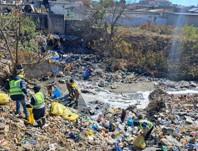
Seitlholo made the call during a river clean-up event held this week at a tributary of the Tolwane River, as part of the Department of Water and Sanitation’s Clear Rivers Campaign, in support of Mandela Month.
“There is a huge crisis that we have in South Africa that we do not talk about, which is the state of our water resources. People do not protest because there is sewerage in the river or in the dams.
“But they protest when there is no water coming from their taps. Ironically, it is the state of the water in our rivers and dams that determine the quality of the water that comes from our taps,” Seitlholo said.
Highlighting the need for a holistic understanding of the water value chain, Seitlholo stressed that the condition of upstream water sources determines the quality of water that ultimately reaches households.
“The public is focused and fixated on the end-product and seem to forget that there is a beginning of the value chain. If the community fails to take care of the beginning of the value chain, then definitely the end-product will be compromised.”
The Deputy Minister expressed concern over the severe pollution of water resources in Gauteng, citing dumping of waste and foreign objects into rivers as a major contributor.
“People have taken a decision that they are not going to be conscious enough about the state of our rivers and dams. They are just going to throw foreign objects into our river streams [and] that is the behaviour. We have messed up our environment as people,” the Deputy Minister said.
He also reminded the community that water is irreplaceable, unlike electricity, which can be substituted with alternatives like gas or wood.
“When there is no water, it just cannot be replaced,” he said.
The river clean-up event saw participation from government officials, INCLUDING residents, local stakeholders, and the City of Tshwane, which assisted with waste collection and disposal.
This collective approach reflects the shared responsibility in safeguarding South Africa’s water resources.
Maintaining clean rivers and catchment areas is critical to reducing pollution, protecting biodiversity, and ensuring the long-term sustainability of water systems.
The river clean-up comes at the backdrop of the Department of Water and Sanitation’s annual Clear Rivers Campaign in support of the Mandela Month, where everybody is called to dedicate their 67 minutes of goodwill activities towards cleaning up streams, wetlands, dams, canals, and any freshwater sources.
The Deputy Minister noted that community-led initiatives like this not only improve environmental conditions but also help raise awareness and fosters lasting behavioral change toward responsible waste management.
“Water is a vital enabler of economic growth, investment, and social development. Therefore, it is crucial for communities living near rivers and wetlands to protect these ecosystems, which are essential for livelihoods and resilience,” the Deputy Minister said.
The Clear Rivers Campaign is observed under the theme: “South Africa is a water-scarce country – clean up and protect our water resources.”
This year’s Mandela Month is commemorated under the theme: “It’s still in our hands to combat poverty and inequality.” – SAnews.gov.za


