


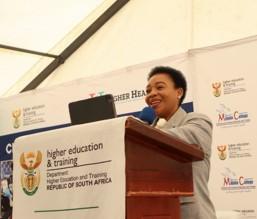
Higher Education and Training Deputy Minister, Dr Nomusa Dube-Ncube, has officially unveiled a facility to provide students with a safe space to seek help and access support for gender-based violence (GBV), mental health challenges and other psychosocial needs.
The first of its kind in the Post-School Education and Training (PSET) sector in KwaZulu-Natal, the Comfort Room was launched at Majuba Technical and Vocational Education and Training (TVET) College’s Dundee Campus, on Wednesday, marking a new national vision for safe, supportive and stigma-free student spaces.
The initiative, implemented in partnership with Higher Health, Majuba TVET College and the KwaZulu-Natal Department of Health, aims to address gaps in reporting and support systems that often leave survivors navigating multiple institutions without adequate assistance.
Dube-Ncube described the facility as an important link between young people and the services available to protect and support them.
“This is a safe, private space on campus where a young person can pause, open up, learn, and be connected to the right help, without having to work out the whole system alone,” Dube-Ncube said.
The launch comes amid high levels of GBV in KwaZulu-Natal. According to figures cited by the Deputy Minister, 1 820 rapes were reported in the province between April and June this year, the highest number recorded nationally during the period. Police also recorded 124 women murdered in the province during the same quarter.
Dube-Ncube said the figures represent only reported cases, with many survivors remaining silent because of fear, stigma and the difficulties associated with seeking assistance.
She said survivors are often required to recount traumatic experiences repeatedly when moving between health facilities, police stations, social workers and the courts, a situation that could result in secondary victimisation and discourage them from pursuing cases.
The Comfort Room aims to help bridge these gaps by connecting students to appropriate services, including professional counselling, healthcare, police assistance and psychosocial support.
Higher Health Chief Executive Officer, Professor Ramneek Ahluwalia and his team are working with the college and other partners to ensure that students can access assistance in a supportive environment.
The facility will host survivor clubs, where affected students can find solidarity and be connected to professional assistance, as well as transforming mentalities clubs aimed particularly at encouraging young men to challenge harmful attitudes and behaviour.
It will also provide peer support forums for young people living with HIV and spaces for discussions on mental health.
Dube-Ncube said Higher Health’s programmes have shown that young people are willing to seek assistance when provided with safe avenues to speak about their challenges.
Over the past four years, more than 394 000 students completed GBV self-risk assessments, with more than 20 000 subsequently coming forward to request help. In addition, more than 188 000 young people had been identified as needing or actively seeking psychosocial support through mental health programmes.
The Deputy Minister said the launch formed part of broader government efforts to strengthen the response to GBV, which was formally classified as a national disaster in November last year.
“What begins in this room today must become part of how the whole country protects its young people,” she said.
Dube-Ncube also called on college management and student leaders to ensure that students know about the facility and trust it enough to use it. She also urged the college to ensure that the room is properly staffed, linked to local healthcare services, police and social workers, and that referrals are followed up.
Addressing young men, she said the responsibility to end GBV cannot rest with women alone, given that men commit the overwhelming majority of such violence.
“The solution must also come from men,” she said, urging young men to challenge abusive behaviour among their peers and promote respect and consent.
Students and members of the public can access support through the GBV Command Centre on 0800 428 428 or by dialling 1207867# from any cellphone. Higher Health’s 24-hour student helpline is available on 0800 36 36 36, or by SMS on 43336.
Childline can be contacted free of charge on 116, while SAPS Crime Stop is available on 08600 10111. In an emergency, the police can be contacted on 10111. – SAnews.gov.za


