


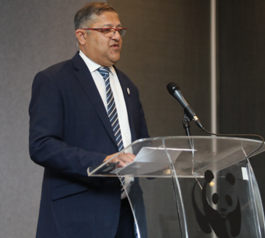
The Deputy Minister of Forestry, Fisheries and the Environment, Narend Singh, has emphasised that safeguarding South Africa’s biodiversity requires a whole-of-government and whole-of-society approach, anchored by a shared national mission.
“Conservation without people is hollow. True success hinges on inclusive, transformative biodiversity management, where local communities are not just beneficiaries, but co-architects and custodians,” the Deputy Minister said on Friday.
This echoes the objectives of the Kunming-Montreal Global Biodiversity Framework to halt and reverse biodiversity loss by 2050.
It includes four goals for 2050 and 23 urgent, action-oriented targets for 2030, which are designed to address drivers of biodiversity decline, such as habitat loss, pollution and invasive species, and to promote sustainable use of natural resources.
As part of these efforts, South Africa is aligning its National Biodiversity Strategy and Action Plan (NBSAP) with this framework.
“This point was brought home to me very strongly just this week. I attended the World Tribal Alliance gathering, which brought together traditional leaders from 15 countries. Their indigenous knowledge is remarkable — and too often exploited. At COP16 in Colombia, we cemented the Cali Call for Action to protect Indigenous Knowledge holders and ensure they benefit economically from the remedies, medicines and innovations derived from their heritage,” Singh said.
He made these remarks during the World Wildlife Fund (WWF) South Africa Annual General Meeting (AGM) in Sandton, Johannesburg, which brought together a diverse and influential cross-section of leaders from business, government and civil society, all united by a shared commitment to conserving the natural heritage.
“It is in this spirit that I call on the WWF to champion community-based natural resource management and co-management agreements; drive skills development, enterprise creation, and market access for youth and women, and strengthen access and benefit-sharing so communities thrive from biodiversity-based economies,” he said.
The Deputy Minister expressed concern about transnational wildlife crime and trafficking.
“This is not just an environmental crisis -- it is an assault on our rule of law, security, economy and biodiverse tourism sector. Criminal syndicates embed themselves in communities, diversify their operations, and exploit corruption and porous borders to traffic high-value species.
“These syndicates are not only involved in poaching — they are also involved in drugs, human trafficking, and other criminal economies. These are mafia-type networks embedded across society.
“I am informed that the first fight against succulent poaching is supported by the WWF. You have provided dedicated personnel to assist in this area, and for that, we are grateful,” Singh said.
Through the implementation of the National Integrated Strategy to Combat Wildlife Trafficking, which was approved by Cabinet in 2023, government is also doing its part in the fight against wildlife crime. - SAnews.gov.za


