


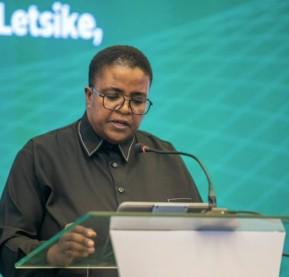
Deputy Minister in the Presidency for Women, Youth and Persons with Disabilities Mmapaseka Steve Letsike has called for stronger regional cooperation and collective action to accelerate efforts to end gender-based violence and femicide (GBVF) across Southern Africa.
Addressing the Southern Africa Regional Convening on GBV Action Coalition Commitments on Tuesday, Letsike said the conclusion of the Generation Equality Forum’s five-year action period must not be mistaken for the end of the struggle against violence and inequality.
She said the true measure of commitments made between 2021 and 2026 will be whether they had translated into national laws, budgets and functioning institutions that improve the lived safety, dignity and freedom of women and girls.
“A cycle may close and a commitment may be recorded as completed. Still, the true measure of our work lies in whether the social and economic conditions that reproduce violence are being changed.
“The credibility of Generation Equality will therefore not be judged by the number of commitments announced in Paris in 2021, but by whether those commitments travelled from international platforms into national laws and budgets, through functioning institutions, and ultimately into the lived safety, dignity and freedom of women and girls,” Letsike said.
She said GBVF remains a profound public, constitutional and developmental concern in South Africa, as violence frequently occurs in intimate relationships, including homes, schools, universities, workplaces, places of worship, and increasingly in digital spaces.
While violence may occur behind closed doors, its consequences extend into health facilities, classrooms, workplaces, police stations, shelters and courts, while also placing significant social and economic costs on families, communities and the State.
Letsike cited research showing the scale of the crisis, including findings from the Human Sciences Research Council that 33.1% of women aged 18 and older have experienced physical violence during their lifetime.
She also highlighted South African Medical Research Council (SAMRC) research indicating that approximately 60% of women murdered in 2020/21 were killed by an intimate partner.
“These figures do not represent unrelated incidents.
“They reveal unequal power reproduced across relationships, institutions and generations,” the deputy minister said.
Legislative and policy protections
Letsike said addressing GBVF requires more than criminal justice interventions, as violence is influenced by social norms, economic conditions, institutional cultures and the quality of the State’s response.
She pointed to South Africa’s constitutional and policy framework, including the National Strategic Plan on GBVF, which identifies six areas of action: leadership and accountability; prevention and social cohesion; justice, safety and protection; response, care, support and healing; economic empowerment; and research and knowledge management.
The deputy minister also highlighted legislative reforms since April 2022, including amendments to laws dealing with domestic violence, sexual offences, bail, sentencing and the participation of complainants in criminal proceedings.
However, Letsike warned that laws do not implement themselves and that their effectiveness is ultimately tested through survivors’ experiences.
“Prevention must begin long before a police docket is opened,” Letsike said.
She called for interventions in schools, higher education institutions and workplaces to challenge harmful gender norms and promote dignity, consent and equality.
Letsike also stressed the need to ensure that services are accessible to survivors, noting the importance of shelters, psychosocial support, healthcare, the Gender-Based Violence Command Centre, Thuthuzela Care Centres and the criminal justice system.
During 2024/25, the National Prosecuting Authority recorded 3697 convictions for sexual offences, while more than 44 000 victims received support through 66 Thuthuzela Care Centres.
However, Letsike said institutional activity must be measured against whether it result in reduced violence, improved access to justice and safer communities.
She further called for greater recognition of violence experienced by lesbian, gay, bisexual, transgender, intersex (LGBTI), and other people of diverse sexual orientation, gender identity, gender expression and sex characteristics.
Letsike welcomed the establishment of the National Council on GBVF as an opportunity to strengthen coordination and accountability across government, civil society and other sectors.
She called for stronger SADC cooperation on prevention, trafficking, migration, technology-facilitated violence, survivor services, comparable data, and sustainable financing.
“If violence and anti-rights organising can cross borders, our solidarity, knowledge and accountability must do the same,” she said. – SAnews.gov.za


