


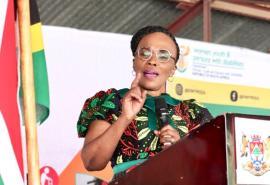
Minister in the Presidency responsible for Women, Youth and Persons with Disabilities, Sindisiwe Chikunga, has called on society to build a truly inclusive South Africa where people with disabilities participate fully and equally in all spheres of life.
Speaking at the launch of Disability Rights Awareness Month (DRAM) 2025 at the Supported Employment Enterprise (SEE) Factory in Kimberley, Northern Cape, Chikunga said this year’s theme: “Celebrating 30 Years of Democracy: Creating Strategic Multisectoral Partnerships for a Disability-Inclusive Society”, is a call to action for government, business, academia and civil society to work collaboratively to remove barriers that continue to marginalise people with disabilities.
“The SEE Factory stands as living proof that inclusion is possible — where persons with disabilities are not spectators in the economy, but skilled workers, producers, and innovators. Your factory represents what is possible when the state, the private sector, academia and civil society work together to transform ability into opportunity, and opportunity into dignity,” Chikunga said.
The Minister reaffirmed government’s commitment to advancing universal access, inclusive education, decent employment, community-based services, and accessible technologies in line with the United Nations Convention on the Rights of Persons with Disabilities (UNCRPD) and the G7 Solfagnano Charter.
Confronting exclusion in education and economy
Chikunga expressed deep concern about the ongoing exclusion of people with disabilities from education and the economy, noting that unemployment among people with disabilities exceeds 80% in some regions.
“When unemployment among persons with disabilities exceeds 80 percent in some regions, we are not seeing the natural workings of our economy — we are seeing deliberate structural abandonment,” Chikunga said.
She highlighted that too many schools still operate in buildings never designed for accessibility, when a child cannot enter a classroom with dignity.
“Resources — especially assistive devices — remain scarce, and many teachers have not been adequately prepared for inclusive classrooms. Technology promises personalisation, yet without equitable access to devices, connectivity and the skills to use them, innovation risks widening rather than closing the gap.
“Participation by children with disabilities still lags behind that of their peers, with only modest improvement in recent years. Educational inclusion is not about “fixing” the learner to fit the system, it is about fixing the system to embrace every learner,” the Minister said.
The Minister also raised concerns about the increased vulnerability of women with disabilities to gender-based violence (GBV), warning that as femicide rates climb, women with disabilities face compounded risk.
She said the department has approached the Minister of Public Service and Administration (DPSA) to issue a Ministerial directive compel all departments to employ people with disabilities, until the 4% public service employment target is achieved.
According to the latest Employment Equity data, people with disabilities make up about 1.2 percent of reported employees in the public service and 1.3% in the private sector, which is far below the 3 percent national benchmark and the 7 percent goal set for the public service.
Cabinet has also called for every department to recruit and plan deliberately towards this target and directed that every board of a public entity must include at least one person with a disability.
She further announced that SEE factories will now be able to supply goods such as furniture, uniforms and linen directly to government departments and entities without undergoing lengthy tender procurement processes, a move designed to preserve jobs for people with disabilities and reduce costs to the State.
“The SEE model makes economic sense: it promotes inclusion, supports local manufacturing, and ensures that public procurement restores both income and dignity.”
Building partnerships that deliver
Chikunga emphasised that the real test of government is whether inclusion moves from paper to practice, whether every school, business and public entity becomes part of the machinery that advances the rights of persons with disabilities.
“A society that is inclusive is a society where persons with disabilities move freely through our cities on public transport designed with them from the start; where buildings welcome everyone through their doors; and where every digital platform — from government services to banking apps — works seamlessly for all South Africans regardless of ability,” the Minister said. – SAnews.gov.za


