


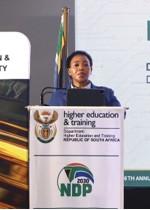
Higher Education and Training Deputy Minister, Dr Nomusa Dube-Ncube has reiterated that skills development should be viewed as a strategic investment in building a capable, professional and ethical public service, rather than merely a compliance requirement.
Addressing the Public Service Sector Education and Training Authority (PSETA) 16th Annual General Meeting (AGM) in Sandton on Thursday, Dube-Ncube said training programmes must translate into better service delivery and tangible benefits for citizens, calling for a stronger link between skills development and improved government performance.
She said government institutions' ability to deliver quality services is directly linked to the competencies, capabilities and professionalism of public servants.
“Beyond reporting on activities and outputs, we must increasingly focus on outcomes and the long-term value created through skills development investments. The critical question is not only how many people were trained, but how training has improved organisational performance, service delivery, and citizen outcomes,” Dube-Ncube said.
She emphasised that skills planning and training interventions should respond to identified institutional gaps and be aligned with organisational priorities, budgets and performance monitoring.
“Employers need to consider whether employees can apply what they learn, whether workplace practice improves, and whether this contributes to better institutional results. This calls for closer integration between skills planning, organisational strategy, budgeting and performance monitoring,” the Minister said.
This, she said, requires coordinated action between the Department of Higher Education and Training, the Department of Public Service and Administration, the National School of Government, PSETA, public service employers and education and training partners.
Dube-Ncube commended PSETA for its governance and performance achievements during the 2025/26 financial year, including attaining 93% of its 28 annual Service Level Agreement targets and 94% of its Annual Performance Plan targets.
She also congratulated the authority on achieving its eighth consecutive clean audit outcome, urging it to maintain this record while placing greater emphasis on performance and impact.
“Public funds dedicated to skills development must deliver tangible results and impact.”
Strengthening skills intelligence
The Deputy Minister highlighted the launch of the PSETA-University of Johannesburg Public Research Observatory as an important intervention to strengthen skills intelligence and support forward-looking workforce planning.
The Observatory brings together evidence on institutional capacity, existing skills gaps and emerging demands to inform policy development and workforce decisions.
Its work includes a skills compendium and skills forecasting, which are intended to help identify changing occupational and competency requirements, including the digital and data capabilities needed in a modern public service.
Dube-Ncube said the value of the initiative will ultimately be measured by how effectively its research informed policy, workforce planning, and decisions on the allocation of public resources.
She also highlighted PSETA's role in supporting the development and quality assurance of occupational qualifications that connect learning directly to the work performed in government.
These qualifications cover areas such as public service administration, general management, senior government leadership, programme management, diplomacy, immigration, and legislative administration.
They combine theoretical knowledge, practical skills, and workplace learning, while providing clearer professional development and career pathways for public servants.
The qualifications also incorporate the values and standards expected in public service, including constitutional principles, ethical conduct, Batho Pele, digital capability, and monitoring and evaluation.
Funding and skills development challenges
Despite the progress made, Dube-Ncube identified limited financial resources as one of the challenges affecting the expansion and sustainability of skills development in the public service.
She explained that public service employers were exempt from paying the Skills Development Levy, leaving PSETA largely dependent on transfers through the Department of Higher Education and Training's Vote 15.
“Public service employers retain their 1% training budget and full autonomy on where these are directed. This creates a continuing challenge in sustaining and expanding skills development across the sector. The cost of training, learner support, and workplace-based learning places pressure on available resources,” she said.
Turning to youth development, the Deputy Minister said Sector Education and Training Authorities (SETAs) has an important role to play in creating pathways from education and training into meaningful employment.
She encouraged PSETA to expand learnerships, internships, bursaries and other workplace-based learning opportunities across national, provincial and local government institutions.
“These interventions provide young people with valuable workplace experience while strengthening the talent pipeline available to the public service,” she said. – SAnews.gov.za


