


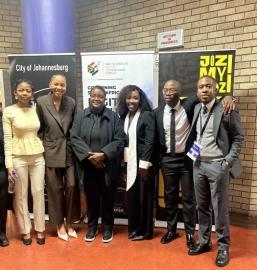
South Africa must empower youth, women and people with disabilities to not just use emerging technologies, but to build it, shape it and drive the digital economy.
This according to Deputy Minister in the Presidency for Women, Youth and Persons with Disabilities Mmapaseka Steve Letsike who delivered remarks at the first Youth, AI and the Future of Work in South Africa Summit.
The summit was hosted by the South African Digital Governance Forum at Wits University in Johannesburg on Monday under the theme: “The AI Divide – Ensuring Youth, Women and Persons with Disabilities are Not Left Behind”.
Letsike called for an inclusive approach to artificial intelligence (AI), noting that AI is no longer a technology confined to engineers and computer scientists, but has become an increasingly influential part of everyday life already being used across sectors, including finance, retail, agriculture, education, healthcare, government and media.
“The much more important question is: on what terms will we participate?” Letsike probed.
She said the traditional understanding of the digital divide – whether people can access the internet – is no longer sufficient in the age of AI.
The deputy minister identified three new frontiers of digital inclusion, namely, connection, capability and command.
“Connection gets a person through the door, capability determines what they are able to do once they enter, [and] command is something deeper still.
“It is the ability to shape the technologies themselves; to build the enterprise, understand the algorithm, govern the data, own the intellectual property, participate in setting the rules and share meaningfully in the wealth that these technologies create,” Letsike said.
While noting South Africa’s progress in expanding connectivity through initiatives such as SA Connect, Letsike warned that access to broadband alone will not guarantee economic inclusion.
“A household can have Wi-Fi and still remain economically excluded.
“A young person can own a smartphone and still lack the literacy required to understand the systems shaping their digital environment,” the Deputy Minister said.
The deputy minister emphasised that the urgency of building AI capability is underscored by South Africa’s economic challenges, including high unemployment, particularly among young people.
Breaking barriers
Letsike noted that AI has the potential to improve productivity, create new opportunities and lower barriers to entrepreneurship, but its benefits will not be distributed automatically.
Furthermore, for women, AI can reduce barriers to entrepreneurship, expand access to knowledge and markets, and make flexible learning more accessible.
However, women also needed to be represented among those developing technologies, financing innovation, governing platforms and owning the wealth generated by the digital economy.
“Automation can inherit a gender,” Letsike warned, noting that the risk existing inequalities can be reproduced through artificial intelligence and biased data.
The deputy minister also highlighted the opportunities AI presented for persons with disabilities, including speech recognition, image description, predictive text and intelligent interfaces.
However, she warned that technology developed without considering people with disabilities can create new forms of exclusion.
“Accessibility must therefore cease to be regarded as an accommodation added at the end of innovation. It must become part of the architecture of innovation itself,” the deputy minister said.
AI literacy
Letsike challenged the belief that young people are automatically equipped for the digital economy simply because they have grown up using technology.
“Knowing how to scroll through TikTok does not necessarily mean understanding why TikTok selected the next video,” the deputy minister noted.
She called for greater investment in AI literacy across society, alongside access to finance, procurement and markets for innovators and entrepreneurs who have historically been excluded.
Additionally, Africa should also ensure that it develops its own technological capabilities, rather than becoming merely a consumer of technologies developed elsewhere.
The deputy minister also urged South Africa to cross the new frontier of digital inclusion together by connecting people, equipping them with the necessary capabilities and ensuring that the power to shape the digital future is increasingly shared across society.
“The frontier now before us asks whether they will have the agency to shape what comes next,” Letsike said. – SAnews.gov.za


